
The wedding band goes on the bottom, closer to the knuckle of the hand, with the engagement ring stacked on top. That's the answer most American couples follow, the order taught at most US ceremonies, and the way nine out of ten wedding-magazine photos are styled. But "does the wedding band go on top or bottom" is a fair question, because plenty of women genuinely wear them the other way around. The reasons are practical, not rebellious. This guide walks through the traditional order and why it exists, the reasons couples reverse it, what each option means for ring care, and a few notes for grooms whose own ring sits next to a watch instead of an engagement ring.
Does the wedding band go on top or bottom?
The wedding band traditionally goes on the bottom, meaning the wedding band sits closest to your knuckle, with the engagement ring stacked above it (closer to the fingertip). That puts the wedding band "first on, last off" in the order you put rings on each morning. So the wedding band goes on first, then the engagement ring, and they come off in reverse.
If your fiancée wears one ring above the other, the conventional order is: wedding band on bottom, engagement ring on top. About 70% of US couples follow this. The remaining 30% reverse it for reasons that come down to comfort, ring profile, or protecting a high-set diamond.
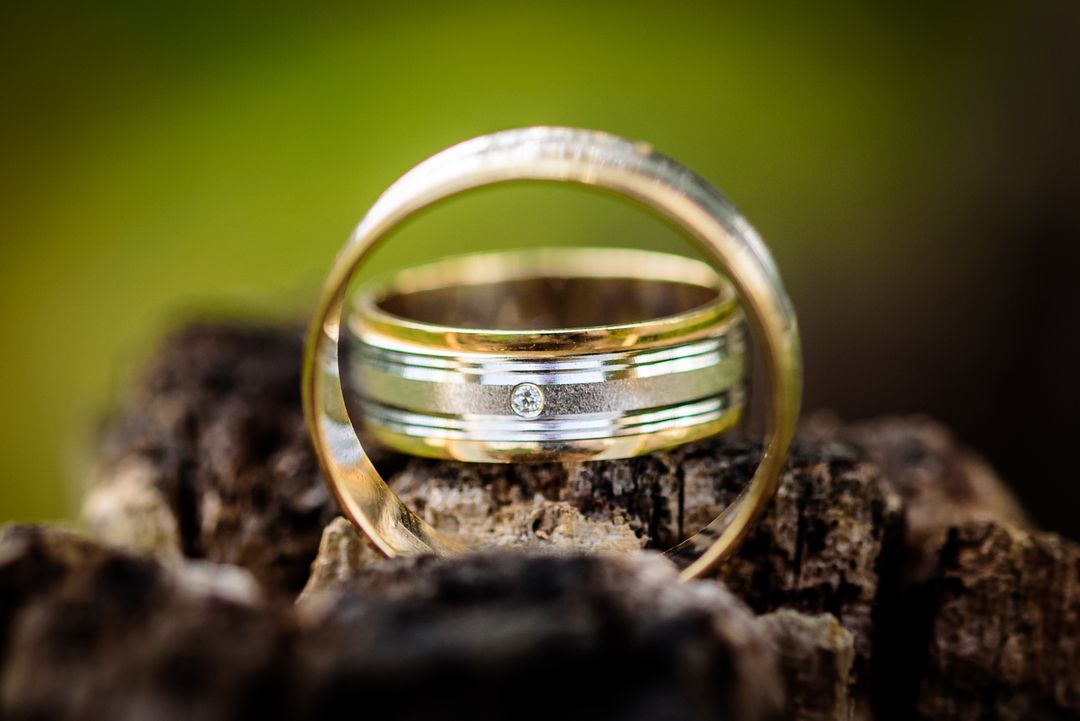
Why does tradition put the wedding band on the bottom?
The tradition comes from the Roman idea of the vena amoris, the "vein of love," which they thought ran from the left ring finger directly to the heart. The wedding band, given as the public symbol of the marriage itself, was meant to sit closest to that vein. Anything else stacked on the same finger went above it.
The biology is wrong (every finger has the same vascular pattern), but the symbolism stuck. The order matters in the wedding ceremony itself: the officiant blesses the wedding band, the groom slides it onto a bare ring finger, and only after the ceremony does the engagement ring go back on top. If the wedding band ended up above the engagement ring, the ceremony would have to be choreographed differently, and most of American wedding tradition is built around the heart-vein order.
Practical translation: wedding band on the bottom is the default because that's how the wedding-vow ritual is staged in nearly every US ceremony, religious or secular.
When does it make sense to wear the wedding band on top?
About a third of women reverse the order. Here are the four most common reasons:
- The engagement ring's setting is too tall. A high-set solitaire creates a visible gap when stacked above a thicker wedding band. Putting the wedding band on top, closer to the knuckle, flattens the silhouette so the engagement ring doesn't tilt forward.
- The wedding band has stones that match the engagement ring better when above. Eternity bands and pavé wedding bands look intentional when they cap the stack rather than sit beneath. Visually, the eye lands on what's closest to the knuckle.
- The engagement ring spins or slides on a smaller finger. Putting the wedding band on top acts as a stopper. The engagement ring sits lower on the finger and stops rotating around.
- The engagement ring is for daily wear and the wedding band gets removed for work. Some women in trades or medical fields wear only the engagement ring during the day and add the wedding band evenings or weekends. Putting the wedding band on top makes that removal easier. It slides over the engagement ring without disturbing it.
None of these reverse the meaning of either ring. The wedding band still represents the marriage, the engagement ring still represents the proposal. The order is mechanical, not symbolic.
What "top" and "bottom" do to ring wear
| Order | What rubs against what | Long-term wear |
|---|---|---|
| Band bottom, ring top (traditional) | Engagement ring shank rubs the band's top edge | Visible groove on the band over years |
| Band top, ring bottom | Wedding band rubs the engagement ring's prongs | Prongs can loosen, diamond check yearly |
| Soldered together | No friction between the two rings | No groove or prong wear, resize is harder |
| Separate hands | No contact at all | No mutual wear, each ring ages alone |
If both rings are softer metals (gold, platinum), constant contact creates a visible groove or thinning over years. Tungsten carbide and titanium wedding bands resist that surface wear better than gold, but the engagement ring above still suffers from the harder edge underneath.
Annual prong checks matter more than the order. Whichever order you use, see a jeweler once a year for a stone-tightness check on the engagement ring. That one habit prevents the lost-diamond stories most couples don't realize are common.
Should you solder your rings together?
Soldering joins the two rings into a single welded piece. Once soldered, the order is permanent. The rings can't be separated except by cutting them apart, which usually means re-soldering or refurbishing both.
Soldering solves three problems:
- The rings stop spinning independently and shifting orientation throughout the day.
- The wedding band stops scratching the engagement ring's underside.
- The visual "gap" between two rings that don't quite nest disappears.
The trade-offs are: resize is harder (the soldered set must be resized as one piece), one bent ring damages the other if you catch it, and removal-for-work is now removal of the entire stack. About 30% of US couples solder. If your wedding band is tungsten carbide, soldering isn't an option, since tungsten doesn't accept solder. The fix in that case is a custom contour band designed to nest tight against the engagement ring without joining.
Men's wedding bands and the order question
For most American men, the order question doesn't apply. A single wedding band sits alone on the left ring finger, and there's no second ring to stack against it. About 95% of US grooms wear only the wedding band.
The 5% who wear an engagement ring (sometimes called a "groom's ring" or "mangagement ring") usually do one of three things:
- Wear both on the same finger, the same convention as women's stacks. Wedding band on the bottom, engagement ring on top. Most common when the engagement ring is plain enough to read as a second band.
- Split across hands, wedding band on the left, original engagement ring on the right. This keeps both rings visible without forcing a stack that may not look right on a thicker male finger.
- Retire the engagement ring, move it to a chain, store it in a box, or pass it down. Some grooms wear the engagement ring only during the engagement, then transition fully to the wedding band on the wedding day.
The men's wedding band carries the entire weight of the symbol, so the choice matters more than for stackers. A clean, low-profile silver tungsten band like Ingot works for guys who want zero ring-on-ring competition. For men who want the ring to feel substantial on its own, without partner-ring stacking complications, the matte black Monolith is the bestseller.
Choosing a wedding band that stacks well
If you're picking a wedding band that has to live next to an engagement ring for the next forty years, there are three tactical considerations:
- Match the metal where you can. A platinum engagement ring next to a yellow gold wedding band looks intentional but takes confidence. A white gold engagement ring stacked with a silver tungsten band reads as a single piece. If you don't want the rings to look mismatched, keep the metal tone consistent.
- Check the band's profile against the engagement ring's shank. A flat band stacks tighter against a flat shank. A domed band leaves a visible gap unless contoured. The right combination of profiles closes the gap and makes the stack feel like one ring.
- Width matters more than style. A 2mm wedding band under a 6mm engagement ring looks tentative. Match width within 1 to 2mm of the engagement ring's shank for visual balance.
The 6mm vs 8mm width guide covers width selection for the groom's own ring. The best wedding band for men guide walks through finishes, profiles, and pairing logic. For the ring lineup itself, the full men's wedding bands collection is here, and the best sellers represent what most grooms pick first.
Black tungsten with a contrast inlay, like the rose-gold-interior Helm, bridges the gap between minimal and statement, and it stacks well next to a partner's diamond stack without competing.
Common questions about wedding band stacking order
Does the wedding band go on top or bottom of the engagement ring?
Traditionally, the wedding band goes on the bottom (closer to the knuckle), with the engagement ring stacked above it. That order comes from the old Roman idea that the wedding band should sit closest to the so-called "vein of love" running to the heart. About 70% of US couples follow it. The remaining 30% reverse it for comfort or to protect a high-set diamond.
Why does the wedding band sit closer to the heart?
The Romans believed the left ring finger contained a vein that ran directly to the heart, the vena amoris. The wedding band was the symbol of the marriage itself, so it was placed first, closest to that vein. The biology turned out to be wrong, but the tradition stuck because the ceremony is staged around it.
Is it OK to put the wedding band on top instead?
Yes. There's no etiquette violation here. Reversing the order is a practical choice when the engagement ring's setting is tall, when the wedding band's profile holds the engagement ring better, or when the engagement ring is removed for work and re-added later. The meaning of each ring doesn't change with the order.
Should the wedding band be soldered to the engagement ring?
It's optional, and about 30% of US couples solder the rings together to stop them spinning and to eliminate friction wear between the two. The trade-offs: the rings can no longer be separated, resize becomes more expensive, and tungsten wedding bands cannot be soldered (use a custom contour band instead).
Do men also stack their wedding band and engagement ring?
The roughly 5% of American men who own both rings sometimes do, but most don't bother. Common male approaches: wear the engagement ring on the right hand and the wedding band on the left, or have the original engagement ring serve as the wedding band itself.
If you're picking the men's wedding band that has to live with this decision long-term, FoundryCut's men's wedding bands collection covers the styles built for daily wear. Related reads: which goes first when stacking and which hand men wear a wedding ring on.


