
For men's wedding bands, the most argued-about choice is 6mm vs 8mm. It's the single biggest decision shaping how your ring looks, feels, and wears over the years, and most guys get no real guidance before they buy. There's no universally right answer. The right width depends on the size of your hand, the work you do, and whether you want the ring to sit quietly on your finger or make a statement. This guide breaks down how 6mm and 8mm compare, who each width suits, and how to decide without second-guessing yourself later.
What does ring width actually mean?
Ring width is the measurement across the top of the band, the part that sits flat against the back of your finger when you look down at your hand, measured in millimeters. A 6mm ring covers about a quarter of an inch of finger, an 8mm covers about a third. That sounds like a small gap on paper, but in the mirror it's a clearly visible difference.
Width and thickness are often confused. Thickness is how far the band sits off the skin. Rings can feel completely different if one is thinner, even if the rings are the same width. Most modern bands hold a thickness of 2.2 to 2.5mm, so when thinking about 6mm and 8mm bands, think about how much of the finger is covered.
Men's rings that are under 5mm tend to look feminine, while rings that are over 9mm look novelty. Widths between 6mm and 8mm tend to be the most popular, which is why this debate is the only one that matters for most buyers.
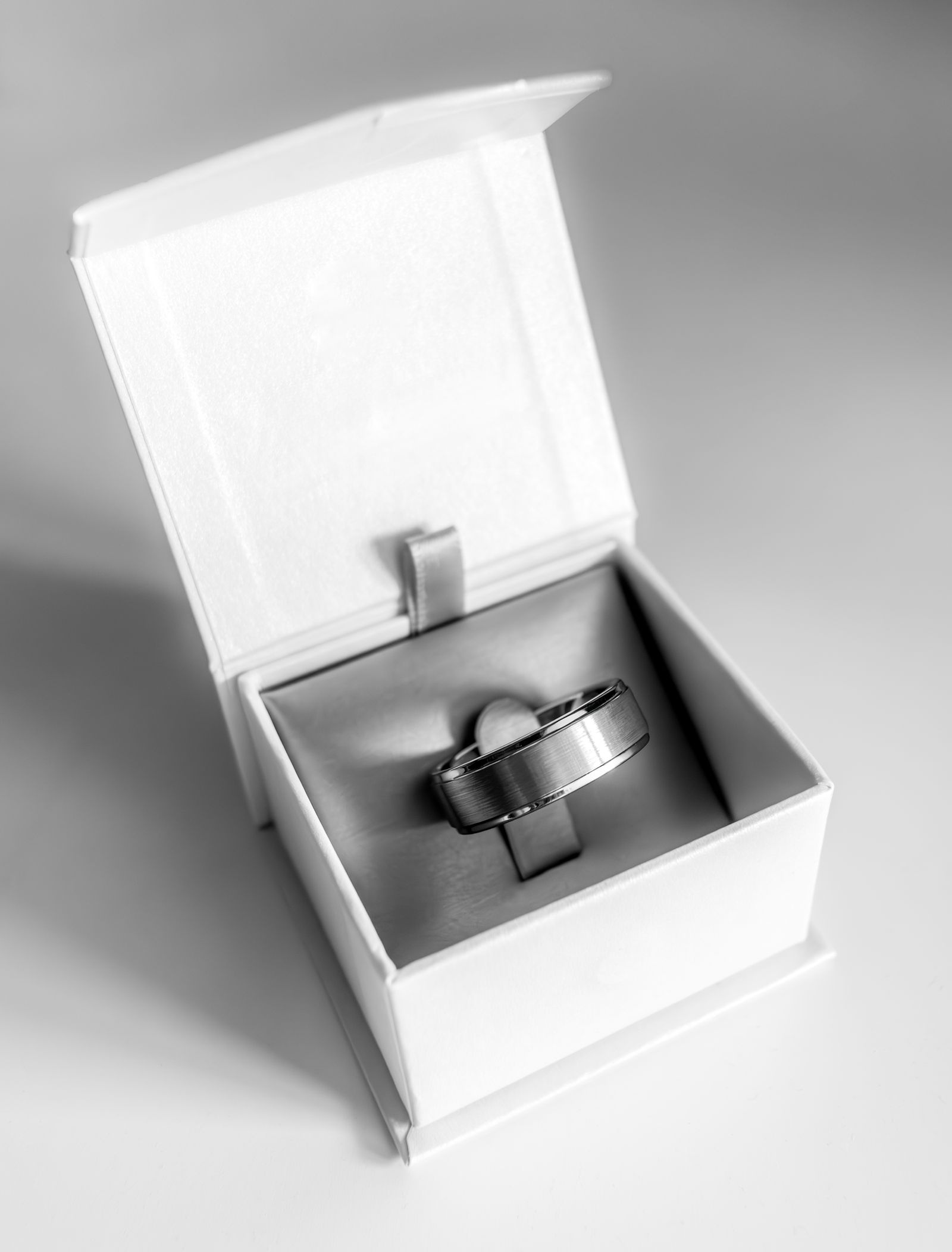
What is the exact difference between 6mm and 8mm?
The short answer: the difference between 6mm and 8mm is 2 millimeters, or about 0.08 inches. That sounds like nothing on paper, but it's roughly a third more finger coverage, enough that the two widths look and feel clearly different in person.
In practical terms, a 6mm band sits just under a quarter inch across, an 8mm just under a third. Line them up and the 8mm reads as the chunkier ring. On the hand, 6mm reads cleaner and flatter while 8mm reads bolder. Neither is really "thicker," since both sit at about the same height off the skin (usually 2.2 to 2.5mm). When someone asks whether 6mm or 8mm is thicker, they almost always mean wider, and 8mm is the wider of the two.
Men's wedding bands come in sizes from 4mm on the small end to 10mm on the large end. Rings sized at 4mm and 5mm are in the dress and stacking ring category, 10mm rings are in the bold category, and rings sized at 6mm and 8mm fall in the middle. Because of this, those are the two sizes that most men get compared to each other. If you're still deciding on a size, it is good to know your size in relation to average men's ring sizes before you fix on a width.
6mm vs 8mm ring: side-by-side comparison
This is how the two widths line up on the ring specs that carry weight. The descriptions below are for a standard tungsten carbide wedding band. The specs will shift a bit for other ring materials, but the differences will remain the same.
| Attribute | 6mm ring | 8mm ring |
|---|---|---|
| Finger coverage | About 1/4 inch | About 1/3 inch |
| Visual presence | Understated, classic | Bold, confident |
| Weight feel | Lighter, barely noticed | Substantial, always felt |
| Best hand sizes | Small to medium | Medium to large |
| Style match | Minimalist, traditional | Modern, statement |
| Adjustment time | A few days | One to two weeks |
| Popularity | ~30% of men | ~60% of men |
This is the main point: for those men looking at tungsten wedding bands, 8mm sizing is the better choice for most. But 6mm sizing is not a compromise, as it is a completely different look. For the right finger, that size can be the better choice.
Who should choose a 6mm ring?
If you lean toward minimalism in your clothing, watch, or accessories, 6mm is likely the size for you. A 6mm wedding band is close to the standard sizing that grandfathers likely wore rings at: that style is timeless and not trendy.
Choose 6mm if:
- Ring size 9 or smaller: 8mm can overwhelm the knuckle and visually shorten your hand.
- Slimmer fingers relative to your frame: proportion matters more than absolute size, a 6mm on a long, slim finger looks intentional while an 8mm can look clamped on.
- Daily hands-on work that closes your fist (trades, welding, lifting): a narrower band presses less into the base of your finger when you grip.
- You're wearing a second ring or stack of rings on the same hand, where 6mm leaves more room.
- You want a ring that disappears from your awareness within a few days of wearing it.
A good example to use for sizing is Monolith band, which comes in both 6mm and 8mm, as does almost every ring we make. Forge and Relic are the two exceptions and are 8mm only. Buying both will allow you to see how the two widths look on your hand while keeping the same finishing, edge details, and weight.
Who should choose an 8mm ring?
8mm is the default size for many modern wedding bands and is what most people have in mind when they describe what a wedding band should look like. It should be a bold ring that can be spotted from a distance as masculine. If your personal style includes bolder watches, chunky boots, and structured jackets, 8mm will definitely fit with the rest of your wardrobe.
Choose 8mm if:
- Ring size 9.5 or larger: bigger fingers need enough visual weight to balance the knuckle, or the ring looks undersized.
- You want the ring seen: an 8mm catches light and reads clearly from a meter away, which a 6mm doesn't.
- You prefer the "substantial" feeling, wanting to feel the ring as a constant reminder rather than forget it's there.
- You like beveled edges, inlays, or two-tone finishes: the extra width gives those details room to breathe, where a flat 6mm can feel crowded with a gold inlay or colored interior.
- You're choosing a statement finish like matte black or a tonal contrast. Helm's black matte body with a rose gold interior relies on an 8mm canvas to show the contrast properly, the same finish on a 6mm would lose its impact.
Hand size, finger shape, and proportion
Ring width is proportional and defined in the context in which the band will be worn. Two people can wear the same width ring and share the same size ring and look drastically different due to varying factors, such as finger length, knuckle size, and hand width.
For people with long, thin fingers, a 6mm band will be a delicate and refined addition. A band that is 8mm will make the finger look like the band is overly tight or constricted. A 6mm band on shorter, broader fingers, will make the band look absent, and an 8mm band will make the finger look well balanced.
To test your finger, flatten your hand and look at your ring finger. If your finger is longer than it is wide, a 6mm band is preferred. If it is a stocky length, an 8mm band is preferred.
These measurements are not hard and fast. Many people with long fingers prefer an 8mm band, and many people with thicker, stockier fingers prefer a 6mm band. If you're having trouble deciding, let proportion be your deciding factor.
Lifestyle and work considerations
The width of the ring also changes how the ring behaves outside of the showroom. An 8mm band has more surface area to feasibly collect scratches, which matters for traditional gold and silver rings. Tungsten is hard wearing, but the trade off flips. The question then becomes, does the wider band get in your way?
For desk work, for going to the gym, for most of the sports, and for roaming daily errands, both widths work perfectly fine. The situations that width matters:
- If you grip tools hard all day, a 6mm feels less bulky at the base of your finger when your fist closes, a subtle but noticeable difference by shift's end.
- For climbing and lifting with grip, wider bands press into the neighboring finger under load, so a 6mm gives you more room.
- Typing surprises people: a thick 8mm can bump the adjacent finger on a keyboard for the first week, though the adjustment passes.
- For glove work, a 6mm slides into a tight glove more easily, while an 8mm can catch on the seam.
For men who work in environments where a ring is a hazard, such as a heavy machinery shop, electrical work, live construction, width is the least of your problems. The real question is whether you should be wearing a metal ring at all, and it's worth being honest about that before you spend money on either width.
How 6mm vs 8mm width affects daily wear
The lifestyle section above covers the obvious work situations. The important part is how 6mm and 8mm feel after six months or twelve months, when you stop noticing the ring. Width changes how the ring behaves during the day and how it interacts with objects you never thought about in the showroom. Tungsten's density is part of the equation as well. An 8mm band has a distinctly greater mass than a 6mm band.
The table below uses feedback from FoundryCut customers to estimate how each width will feel in everyday life. Tungsten's hardness is the same at either width, so the choice comes down to how the ring fits into your day rather than how it holds up.
| Daily-wear scenario | 6mm experience | 8mm experience |
|---|---|---|
| Getting used to it | Most men forget it's on by day 2 or 3. | First week feels "there" from the extra contact area, but it fades by week 2. |
| Ring spin / rotation | Lower inertia means it rotates more easily, so sizing margin matters more. | More mass and contact area keep it oriented better between adjustments. |
| Sleeping with it on | Doesn't press against neighboring fingers when your fist relaxes overnight. | Some feel it press against the adjacent finger side-sleeping, which is why many remove 8mm rings at night. |
| Hand-washing and soap | Slimmer profile rinses cleaner, with less residue under the band. | More interior surface to dry, worth an extra few seconds to avoid soap film at the seam. |
| Hot weather / sweating | Less contact area means less heat trapped against the skin in summer. | Noticeably warmer above 90°F, though most don't mind, and some swap to silicone in heatwaves. |
| Tight gloves and gear | Slides into nitrile, work, and bike gloves without catching on the cuff. | Can snag on a tight glove cuff, so many size up half a glove or remove the ring first. |
| Watch + ring layering | Reads casual, working under any watch strap from leather to NATO. | Reads as a statement and pairs well with thicker watches like a Submariner or G-Shock, keeping wrist-and-hand styling balanced. |
| Gym and lifting | Less material presses into the next finger gripping a bar, so most keep it on without thinking. | Noticeable pressure hits the adjacent finger during heavy lifts, so the best practice is removing any metal ring for barbell work. |
| Typing and keyboard work | No interference, it disappears under the keys. | Mild bump against the next finger for the first week, an adjustment that fades with muscle memory. |
| Photos and ceremony presence | Reads clean and modern in close-ups, pairing naturally with slim engagement bands. | Reads bold and traditional, holding up in wide ceremony shots and flat-lay photography. |
The pattern shows that the 6mm width has the advantage of disappearing into the background of your day. The 8mm width is more visible and thus more appropriate for styling alongside other wrist gear like a watch. The width of a ring does not answer the question of how the material will wear and tear. That question is answered by looking at the material itself. All of the FoundryCut bands are composed of nickel-bonded tungsten carbide at both widths.
If you spend most of your day by a keyboard and want a ring that is unnoticed, go for 6mm. If you want a ring that is part of the outfit, visible across the room and balanced with your watch, go for the 8mm. Most men choose a width based on the material they fit with the clothes they wear most often, rather than how the ring looks on the first wear.
How to choose without trying both on
For most shoppers, trying on rings in both widths is not an option. In that case, follow this method to help you choose with confidence:
- Know your ring size first, since width decisions hinge on finger size. If you haven't been sized, our no-BS guide to measuring men's ring size at home walks you through it. A ring that fits wrong feels worse in 8mm than in 6mm, since there's more material pressing on a knuckle that isn't sized right.
- Measure two strips of paper, one cut 6mm and one 8mm. Wrap each around your ring finger and compare how it looks and feels making a fist, the closest you'll get to trying both without buying both.
- Check your other accessories: pull out your watch and any bracelets you wear and lay them on the table. If everything you own leans thin and minimal, a 6mm will match. If your watch is 42mm or larger, your wrist is used to visual weight, so go 8mm.
- Choose by finish, then confirm width. If you're set on a specific finish, like Tide's black matte with blue inlay, check which widths that finish actually ships in before you settle on a number. Most statement finishes live at 8mm because the canvas supports the detail.
- When in doubt, pick 8mm, the more common men's width in 2026 and one that reads modern and confident. Unless you have a specific reason to go narrower (small hand, minimalist style, trades work, finger proportion), it's the lower-regret default.
Whichever you land on, the band matters more than the millimeter. Both widths wear well, look good on most men, and hold up for decades in a quality material. If you're still weighing material as well as width, our guide to tungsten rings pros and cons is a good next read, and our post on tungsten carbide covers why tungsten outlasts softer alternatives at either width.
Common questions about 6mm vs 8mm rings
Is 8mm too wide for a men's wedding band?
No, the most common width of tungsten, titanium, and ceramic rings used to make men's wedding bands in North America is 8mm. If you have a ring size of 8 or less, have slim fingers, and wear a wedding band that is 8mm in width, then yes, the 8mm width is too wide. However, for men with ring sizes of 9 or larger, the 8mm wedding band is of an appropriate width.
Does a 6mm ring last as long as an 8mm ring?
Yes, the lifespan of a ring is determined by its material, not its width. A 6mm tungsten band will outlast a 6mm or 8mm gold band because tungsten is roughly four times harder. Width only affects the visual scale and how the ring feels on your finger, not how long it survives.
Can I switch from 6mm to 8mm later if I change my mind?
You can buy a new wedding band, but you can't make an old wedding band larger to accommodate the new width. Tungsten is a hard material and cannot be resized in either direction. If you want a band to last, then choose the width you want, or if you want a band that is only available in one width, then choose that band to simplify your decision.
Which width is more comfortable for everyday wear?
6mm tends to be more comfortable for the first week because there's less material pressing against adjacent fingers when your hand is closed. After two weeks, most men report that both widths feel the same, you stop noticing either once your finger adjusts. Comfort fit (a curved interior profile) matters more than width for long-term comfort.
Do women ever wear 6mm or 8mm rings?
6mm is on the wider end of wedding bands for women but well within range, especially for a statement look. 8mm is rare for women and reads distinctly masculine. If you're shopping a matched set, 6mm for her and 8mm for him is the most commonly sold pairing for couples who want both rings to look balanced side by side.
What's the difference between 6mm and 8mm in millimeters and inches?
The difference is 2 millimeters of width, or about 0.08 inches. A 6mm band sits just under a quarter inch across. An 8mm band sits just under a third of an inch. That 2mm gap works out to roughly a third more width, which is enough to be clearly visible on the hand even though it looks tiny written down.
Is 6mm or 8mm thicker?
8mm is wider, not thicker. Width is how far the band spans across your finger. Thickness is how far it stands off your skin, and that stays about the same (roughly 2.2 to 2.5mm) on both. So if you mean which one covers more finger, it is 8mm. If you genuinely mean height off the skin, the two are about equal.
What's the most popular men's wedding band width?
8mm is the most common men's wedding band width in 2026, with 6mm second. Together those two cover the large majority of men's bands sold. Widths below 6mm tend to read as dress or stacking rings, and widths above 8mm are usually a deliberate statement rather than the default.
Monolith is the best place to start your search for rings in these two widths. It is the only FoundryCut style available in both 6 mm and 8 mm widths. These rings have a matte black finish with a beveled edge. These two rings are the only variable in this situation. You are welcome to view the men's tungsten ring collection to see the different finishes. Each ring is nickel-bonded tungsten carbide. A fast shipping option is available. If your size changes after your purchase, please read about whether you can resize a tungsten ring.
FoundryCut rings in both widths
Two FoundryCut styles give you the option to style in your choice of 6 mm or 8 mm cut width options within the style, thus giving you the option to select the best proportion for your hand without compromising your favorite style.
- Monolith, matte black, beveled edge, the cleanest comparison between the two widths.
- Anvil, hammered finish in black, gold, silver, or two-tone, also available in both widths.
- Browse the full lineup → Most other styles ship in 8mm only.


