
A meteorite wedding band is the only ring you can buy that is older than the planet you are standing on. That is the appeal, and it is a real one. The part most stores skip is that the same iron which makes the pattern possible also makes the ring rust, and that changes how you own it. This guide covers what a meteorite band is made of, why the surface pattern is so hard to fake convincingly, what you actually pay for, and where tungsten carbide is the better answer for the way most men wear a ring.
What Is a Meteorite Wedding Band Actually Made Of?
Almost every meteorite wedding band on the market uses a slice of an iron meteorite, and almost all of those come from one of two falls. Gibeon, found in Namibia, gives the fine crosshatched lines most people picture. Muonionalusta, from northern Sweden, has a coarser, blockier grain. Both are iron and nickel that cooled inside the core of a shattered asteroid at something close to a few degrees per million years, which is the only reason the pattern exists at all.
That pattern has a name, the Widmanstatten figure, and it is two iron-nickel minerals grown into each other in flat bands. You cannot see it on a raw slice. A jeweler has to cut the meteorite, flatten it, polish it, then etch the face with a weak acid that eats one mineral faster than the other. The lines you end up with are a cross section of a crystal that took millions of years to form, so no two rings match and no factory can reproduce it convincingly.
The other thing to understand is that the meteorite is rarely the whole ring. Iron meteorite is brittle and it does not bend, so a solid slice cut into a full band tends to crack. Most makers set the meteorite as an inlay in a sleeve of titanium, gold, or another metal that carries the structural load. When you read "meteorite ring," picture a meteorite face on a metal body rather than a ring cut from a single piece of space rock.
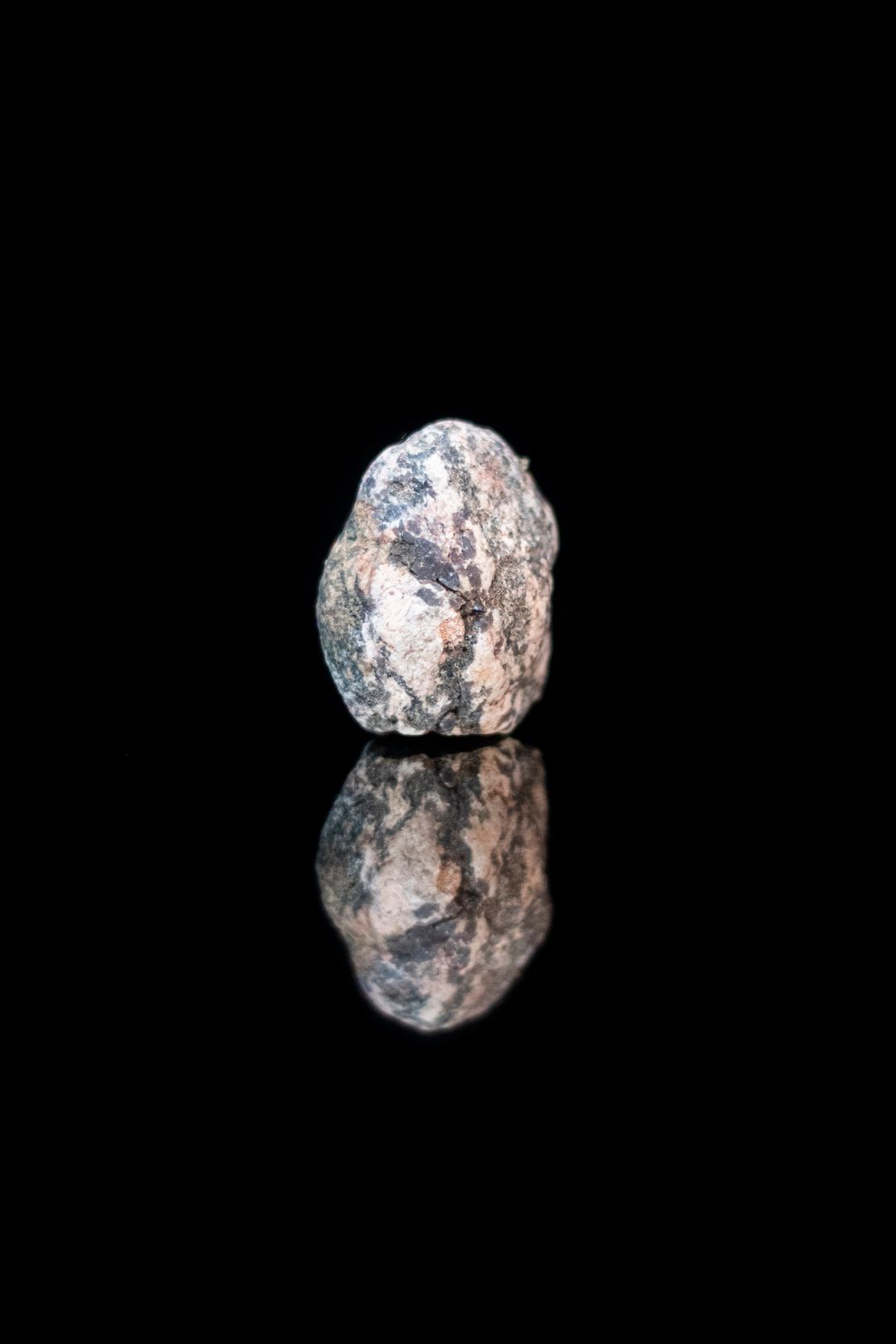
Why Meteorite Rings Rust
Iron meteorites spent their whole existence in vacuum. Oxygen and humidity are new to them, and once they land they start corroding. Many of them also carry chlorine-bearing minerals picked up in space, and those pull moisture out of the air and keep an oxidation reaction running from the inside. Collectors call it lawrencite disease or meteorite rot, and it is why serious specimens live in sealed cases with desiccant.
On a ring, makers slow this down rather than stop it. The etched face gets sealed with a clear coating, a wax, or a thin plating, and the owner is told to keep it dry, take it off in the shower, and re-oil or re-coat it periodically. Done properly the ring holds up fine for years. Skipped for a season, an orange bloom comes up through the pattern and the fix is a trip back to the maker for a re-polish and re-etch.
This is the honest dividing line between meteorite and every other men's band. A gold ring left in a gym bag is a gold ring when you find it. A meteorite ring left in a gym bag has started a chemical process, and that process removes material every time it is corrected. It is not fragile so much as high-maintenance, and it wants an owner who is fine with that trade.
Is Meteorite Harder Than Tungsten?
Iron meteorite sits in roughly the same hardness band as mild steel, well under tungsten carbide at 9 Mohs, which means it marks. Set an etched face against a granite countertop for a couple of years and the raised lines soften, which is a slower version of the same re-polish conversation. Tungsten carbide sits near the top of the scale used for ring materials, well above steel, which is why a tungsten band keeps a machined finish under work that would dull a softer metal.
Weight goes the other way from what people expect. Meteorite is iron, so a meteorite band feels close to a steel ring, moderate and unremarkable. Tungsten carbide is far denser, and the first thing most men notice picking one up is the heft. Some read that as quality and some find it distracting, so it is worth trying a width before committing.
| Feature | Meteorite band | Tungsten carbide |
|---|---|---|
| What it is | Iron-nickel meteorite slice set into a metal sleeve | Nickel-bonded tungsten carbide, machined solid |
| Surface | Etched Widmanstatten crosshatch, different on every ring | Matte, polished, hammered, stepped or inlaid finishes |
| Hardness | Around mild steel, so the etched relief softens over time | Among the hardest materials used in rings |
| Corrosion | Rusts if the seal lapses, needs periodic re-oiling | Does not rust in normal wear |
| On the hand | Moderate weight, close to a steel band | Noticeably dense, the weight is the signature |
| Resizing | Not practical once the inlay is set | Not resizable, exchanged for another size instead |
| Price tier | Gold and platinum territory | Entry to mid tier |
Why Do Meteorite Wedding Bands Cost So Much?
Meteorite bands land in the same bracket as gold and platinum, and occasionally above it. The material itself is part of that, but the bigger driver is waste and labor. A slab has to be cut, iron meteorite eats blades, and slices crack on the way through. Any piece with an interesting grain has to be oriented so the pattern reads well on a curve, and the offcuts are scrap. Add the sleeve metal, the etch, the seal, and the fact that the maker will likely see the ring again for service.
Supply is the other half of it. Namibia restricted export of Gibeon meteorite years ago, so the material circulating in the trade is largely stock that left the country before then. There is no new supply arriving on a schedule, which puts a floor under the price that has nothing to do with how the ring is made.
Against that, a tungsten carbide band is machined from a material produced industrially by the tonne. Two rings from the same run are identical, which is a downside if you want a one-off and an advantage if you want to replace a lost ring with the same thing five years later.
How Can You Tell a Real Meteorite Band From a Fake?
The pattern is the tell, and it is hard to counterfeit convincingly. Real Widmanstatten lines run in a few distinct directions across the face, they vary in width, and they carry small irregularities where the crystal growth was interrupted. Printed or laser-etched imitations tend to repeat, to hold a uniform line weight, and to look the same on every ring in a listing photo.
Ask which fall the material came from. A maker working with real meteorite will say Gibeon or Muonionalusta without hesitating and will usually supply a certificate naming it. Vague answers about "space metal" or a "meteorite-style" finish tell you what you need to know. Watch the wording too, because "meteorite pattern" and "meteorite inspired" are both legal ways to describe a ring with no meteorite in it.
Damascus steel gets confused with meteorite for the same reason, since both show flowing lines from two metals behaving differently. The patterns come from opposite processes, one folded and forged by a smith and one grown in space, and Damascus is the cheaper of the two by a wide margin.
Living With One: Sizing, Water and Repair
Get the size right the first time. A meteorite inlay is bonded into a channel, and stretching or cutting the sleeve to resize risks the bond and the pattern alignment. Most makers replace rather than resize, which means paying again. If your fingers swing with heat or exercise, measure across a few days before ordering, and read up on how a band should actually sit rather than guessing between two sizes.
Water is the daily rule. Off for showers, dishes, swimming and the gym, and dried properly if it does get wet. Chlorine and salt water are worse than tap water. Once or twice a year the face wants a light oiling with a non-acidic oil, and the maker will tell you which one they used.
Emergency removal is worth knowing before you need it. A meteorite band with a titanium or gold sleeve cuts the way that sleeve cuts, so an ER can usually get through it. Tungsten behaves differently, and a tungsten ring is cracked off with a vise-grip tool rather than sawn. Both come off, just by different methods, and it is worth telling a partner which one you are wearing.
Who Should Buy Meteorite, and Who Should Not
Buy meteorite if the story is the point, if you want a ring nobody else has, and if a maintenance routine sounds like part of owning something rather than a chore. Plenty of men wear one for decades and enjoy the ritual of it. Office work, careful habits and a second ring for rough days all help.
Skip it if you work with your hands, spend real time in water, or know yourself well enough to admit the ring is going in a drawer between wearings. Trades, medical work, gym-heavy routines and anything involving chemicals will fight a meteorite band. So will forgetting it in a wet coat pocket.
If what pulled you toward meteorite was the look of deep space on your hand rather than the provenance, there is a middle path. Cosmic inlay rings put a star-field of crushed stone and opal into a black tungsten body, which gets the visual without the rust schedule. Orbit and Nova are the two we build that way, and neither is meteorite, which we would rather say plainly than let you assume. If the draw was texture instead, Forge gets there with a hammered face and no upkeep at all.
Common Questions About Meteorite Wedding Bands
Do meteorite wedding bands rust?
Yes. Iron meteorite corrodes in ordinary air and humidity, and many pieces carry chlorine-bearing minerals that keep the reaction going from within. Makers seal the etched face and owners re-oil it periodically, which manages the problem rather than ending it. A neglected ring shows orange staining through the pattern and needs a re-polish and re-etch to correct.
Are meteorite rings tough enough for daily wear?
They are wearable daily, with conditions. Iron meteorite is around the hardness of mild steel, so the raised etched relief gradually softens with contact, and the material dislikes water and chemicals. Men in office roles tend to do fine. Trades, medical work and anything wet are where owners end up with a second ring for workdays.
How much does a meteorite wedding band cost?
They sit in gold and platinum territory rather than the entry bracket, and the reason is mostly labor and waste rather than the rock. Cutting iron meteorite destroys blades, slices crack, and the pattern has to be oriented before anything is set. Restricted supply of Gibeon material from Namibia keeps a floor under it as well.
Can a meteorite ring be resized?
Usually not, because the meteorite is bonded into a channel in a sleeve, and stretching or cutting that sleeve risks the bond and throws the pattern out of alignment. Most makers replace the ring instead, at cost. Measuring carefully across several days before ordering is the cheapest step in the whole process.
Is the meteorite in a ring really from space?
In a genuine ring, yes, and it is nearly always Gibeon from Namibia or Muonionalusta from Sweden. The crosshatched Widmanstatten figure only forms during extremely slow cooling inside an asteroid core, so it cannot be manufactured. Listings that say meteorite-style, space metal or meteorite-inspired are describing a look, not a material.
What is a good alternative to a meteorite ring?
It depends which part appealed. For the deep-space look without the corrosion routine, a cosmic inlay ring on a black tungsten base gets close. For a one-of-a-kind surface pattern at a lower price, Damascus steel is the closer match. For hard wear with no maintenance at all, plain tungsten carbide in a matte or hammered finish is the practical answer.
Meteorite is a real thing worth wanting, and it asks for something back. If you want the look on a ring you can wear through a workday and forget about, browse the cosmic inlay collection or the wider men's wedding bands range, where every style is nickel-bonded tungsten carbide built for daily wear.


