
The bride traditionally buys the groom's wedding ring, and the groom traditionally buys the bride's. That has been the default in American weddings since the 1940s, but today's couples are split roughly in half on whether they follow that pattern at all. About one in three couples now buys their own bands, jointly, out of a shared account. Another big slice swap who pays based on who has more disposable income at the time. The "right" answer for who buys the groom's wedding ring is whatever you both decide, but the etiquette gets complicated once you factor in who shops, who chooses, and what the gift symbolizes. This guide breaks down the tradition, the modern realities, and how American couples are actually handling it in 2026.
Who traditionally buys the groom's wedding ring?
American wedding etiquette from the post-WWII era onward held that each partner buys the other's wedding ring. The groom buys the bride's engagement ring and her wedding band. The bride (or her family, historically) buys the groom's wedding band. Each ring is a gift from one partner to the other, given during the ceremony when the officiant says "with this ring, I thee wed."
That tradition came from a few practical places. Pre-1970s, men's wedding bands weren't even universal in American culture. They only became standard during WWII, when soldiers wanted a visible reminder of home. By the time men's bands were normal, women had increasingly entered the workforce and could afford to buy them. The "bride buys the groom's ring" custom filled in the symmetry: each gives the other a band, each receives one.
If your family is traditional, this is probably the script they expect. The groom and his side cover engagement-ring and proposal expenses. The bride and her side cover the men's band.
How do modern American couples handle it?
The honest answer is: most American couples in 2026 do not follow the tradition strictly. Survey data from the wedding industry shows roughly:
- About 35% of couples buy their bands from a joint account they fund together
- About 25% follow the traditional pattern (each partner buys the other's)
- About 25% have whichever partner has more disposable income at the time cover both rings
- About 15% receive one or both rings as a family gift (parent, grandparent, sibling)
The reason for the shift is logistics rather than gender politics. Couples in their late 20s and 30s, marrying after years of cohabitation and shared finances, already have a joint approach to large purchases. Splitting "who pays for what" feels artificial when one of you handles the rent and the other handles groceries.
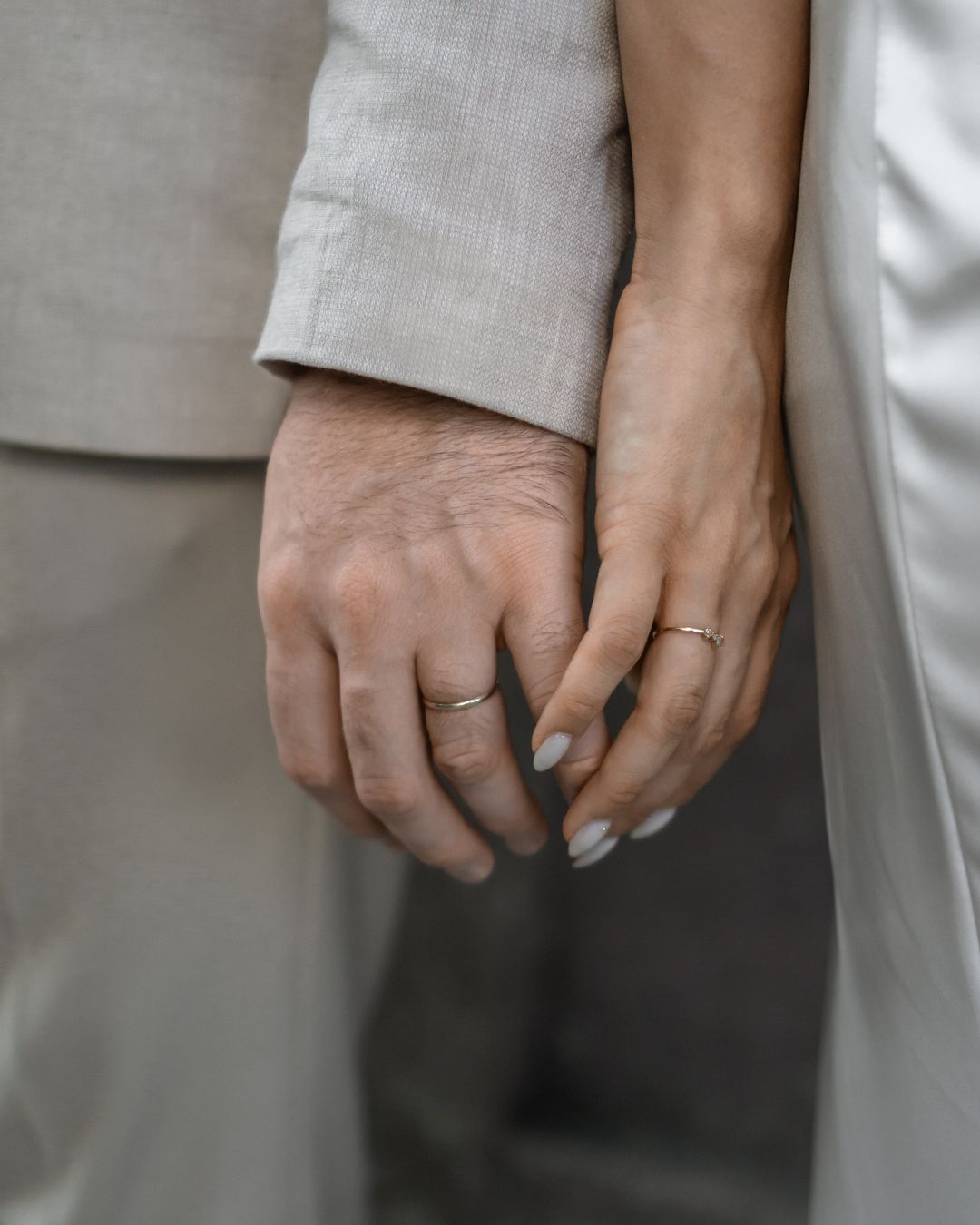
Who shops for the ring, and who pays for it?
One thing the etiquette books often miss: the question "who buys it" has two parts that don't have to match.
Who pays is the financial side. Whose card or whose account funds the purchase.
Who shops is the experiential side. Who picks the style, the metal, the width, the finish.
In the most traditional version, the bride does both. She shops alone and pays alone, then surprises the groom with the band at the ceremony. That's increasingly rare in 2026. More common is some variant where the groom is involved in choosing, regardless of who pays:
- Both shop together, one pays
- Both shop together, both pay (joint account)
- Groom picks 2 to 3 options, bride picks the final one, either pays
- Groom picks alone, either pays
For tungsten or any modern men's ring, where comfort, weight, and width matter a lot, having the groom involved in shopping is increasingly the norm. The bride buying a band sight-unseen rarely produces a ring he actually likes wearing.
Four common arrangements (and which couples pick which)
Here are the four arrangements you'll see most often in American weddings today, with notes on which tend to pick each one:
| Arrangement | How it works | Who tends to pick this |
|---|---|---|
| Traditional gift | Bride pays for groom's ring, groom pays for bride's ring, and each surprises the other at the ceremony | Couples who lean traditional, religious ceremonies, families where parents fund the wedding |
| Joint purchase | Both rings paid from a shared account, shopped together, no "who gives what" framing | Couples who already share finances, cohabitating before marriage, pragmatic over ceremonial |
| Higher-earner pays | Whichever partner has more disposable income at the moment covers both bands | Couples with significant income gap, one partner in school or starting a business |
| Family gift | One or both rings funded by a parent, grandparent, or sibling as a wedding gift | Couples where family is heavily involved, cultures where family gifts are expected |
What about the gift element?
Even when the bride doesn't strictly pay for the groom's band, many couples preserve the "gift" element symbolically. Common variations:
- The bride keeps it hidden until the ceremony. Even if it was bought from a joint account, she holds onto it and presents it as a "gift" during the ring exchange.
- One partner picks, the other doesn't see it until the day. Common when one of you has a strong design sense and the other is happy with any plain band.
- Engraving is treated as the gift. The ring itself comes from a joint purchase, but one partner pays separately to engrave the inside with a date, initials, or short message, keeping the "I bought this for you" gesture intact.
If you want the symbolism of a gift but the practicality of a joint purchase, engraving is the cleanest move. Most tungsten rings can be laser engraved on the inside without affecting the band's exterior or hardness. For more on what is and isn't possible with tungsten engraving, see our guide to tungsten ring engraving.
How to decide what works for you
Three questions to discuss before you decide who buys what:
What does each side's family expect? If the bride's family is traditional and expects to fund the men's band as part of "covering the wedding," that's worth factoring in, not because you have to follow expectations, but because rejecting them invites questions you may not want to answer six times.
How do you already handle major purchases? If you have a joint account for big-ticket items, buy the rings out of it. If you keep finances separate, the traditional "each buys the other's" arrangement maps cleanly onto your existing pattern.
How much does the "gift" symbolism matter to either of you? Some grooms love the idea that the ring on his finger is a gift his partner picked out and paid for. Others would rather pick the band themselves and find the gift framing forced. Talk about it, because there's no wrong answer but there is a wrong assumption.
Whatever you decide, FoundryCut's pricing keeps the band itself in a manageable range, Monolith and Ingot are the cleanest entry points at the lowest tier, and the full men's wedding bands collection covers every style without surprise pricing. For couples who want to coordinate, the best sellers collection shows what most American grooms in 2026 are actually choosing.
If you're still working through the broader pricing question, our honest guide to wedding ring cost covers what a fair budget actually looks like across categories.
Common questions about who buys the groom's ring
Is the bride supposed to buy the groom's wedding ring?
Traditionally yes, each partner buys the other's band as a gift exchanged at the ceremony. In 2026, only about a quarter of American couples follow this strictly. Joint purchases and higher-earner-pays arrangements are now equally common.
What if we both want to pick the rings together?
That's the most common modern arrangement. Shop together for both bands, fund from a joint account or whoever has the bandwidth. The "gift" element can be preserved through engraving or a small ceremonial moment if it matters to either of you.
Should the groom's ring cost the same as the bride's?
No rule says so. Most men's bands cost less than engagement rings (no center stone), so they're typically a smaller line item. What matters is that both partners are happy with what they're wearing, not that the price tags match.
Who buys the groom's ring in a same-sex wedding?
Whoever the couple decides should buy it. Same-sex couples tend to lean further toward joint purchases, with about 50% buying both rings from a shared account, but every variation in the chart above shows up too. There is no traditional script, so couples build their own.
What if my family wants to pay for the ring and I don't?
This is a common situation. The clean answer is to thank them and politely say you've already taken care of it. The middle-ground answer is to accept partial help, where they cover the cost of engraving or a portion of the band. Either way, the ring on your finger should reflect what you and your partner chose, not what someone else funded.
The tradition gives you a starting point. The reality gives you flexibility. The right answer for who buys the groom's wedding ring is whatever lets both of you walk away from the ceremony with bands you actually love wearing. Browse the men's wedding bands collection together. That's usually the right first step regardless of who's paying. If the groom is also sorting out gifts for his own wedding party, our groomsmen gift guide breaks down which categories actually get used after the wedding.


