
On average, ring resizing costs between $20 and $150, depending on the metal, how far you're resizing the ring, and if there are any stones obstructing the resizing. Understanding how prices can change can keep a jeweler from trying to upsell you on a $200 resizing that should cost $40. This guide covers the price differences in metals when resizing, why resizing a ring to a bigger size costs more than a smaller size, and the only scenario where a ring cannot be resized: modern tungsten and ceramic bands, which do not resize but can be exchanged for a different size.
How much does ring resizing cost?
For a plain metal band with no stones, most jewelers charge $20 to $80 to resize a ring. Simple work on silver or standard gold sits at the low end, while platinum, wider bands and bigger size jumps push toward $100 and above. Add gemstones, channel settings or an eternity design and the price climbs again, often to $150 or more, since the setter has to protect or reset every stone.
These prices are just estimates. Prices can change along with the jeweler's availability, the store's location, and the shop's preferred design. A store in a higher priced area will offer higher prices than a store in a mall, and a mail-in store may be cheaper than both in person options. Always get the estimate in writing before you give the jeweler your ring, and ask if the quote covers refinishing to prevent an obvious seam.
It is a common misconception that all rings can be resized. In truth, a few hard metals resist it entirely: tungsten carbide, cobalt, and ceramic cannot be resized because they cannot be cut or bent. Most reputable jewelers will not resize a ring made out of one of these materials. Instead, a size exchange has to be done.
How much does resizing cost by metal?
The biggest factor determining the cost of resizing a ring is the metal of the ring. Softer metals take less time and skill to resize, and so cost less. Harder metals take more time and skill and therefore cost more, and some cannot be resized at all. Most wedding-band metals will fall in this range.
| Metal | Typical resize cost | What to know |
|---|---|---|
| Sterling silver | $20 to $50 | Soft and easy to work, cheapest common metal to resize |
| Yellow / rose gold | $30 to $80 | Straightforward, cost rises with karat, width, and size change |
| White gold | $50 to $100 | Often needs re-plating with rhodium after the work, which adds cost |
| Platinum | $75 to $150 | Dense and high-melting, takes more time and a specialist bench |
| Titanium | Rarely resized | A few specialists size down slightly, most shops decline it |
| Tungsten / ceramic / cobalt | Not resizable | Too hard to bend, exchanged for a new size instead |
If you have a tungsten ring and are concerned about the bottom range of costs, you do not have to worry. A size-exchange policy will cost you significantly less over time than a metal that requires you to pay to resize it every time your fingers swell.
What you are actually paying for
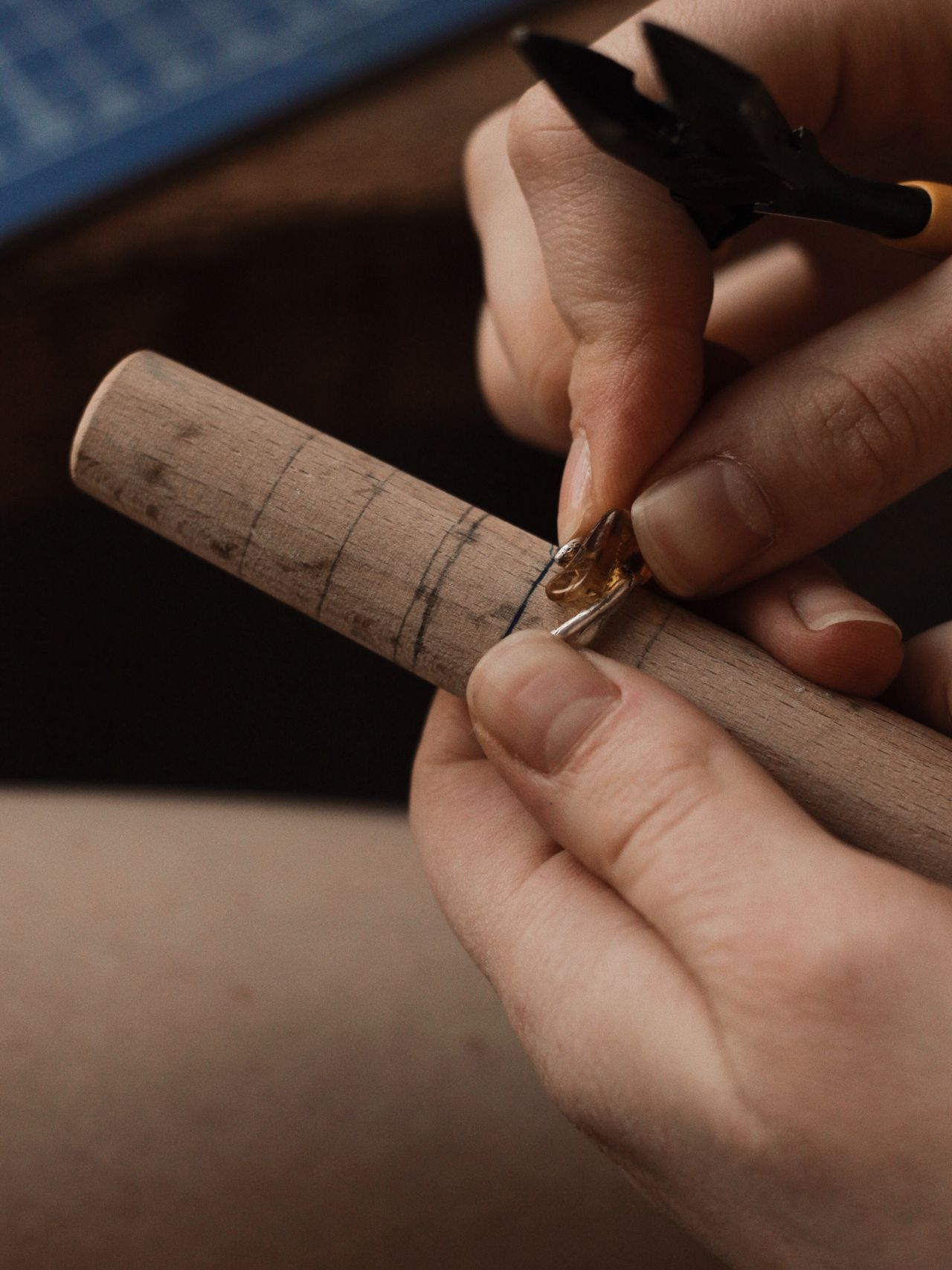
For a customer, resizing rings feels like a snap. For a jeweler, there is a lot of work. The ring has to be cut to remove or add metal, then rejoined with either solder or a laser. Finally, the seam goes through some tedious filing, sanding, and polishing. For the cost, there are a few factors to consider.
- Metal type and width: harder metals and wider bands take more bench time. An 8mm platinum band is a bigger job than a thin silver one, and the quote reflects it.
- How far you're moving: a half-size adjustment is quick, but jumping three or four sizes means removing a wedge or splicing in a fresh length of matching metal, closer to fabrication than a tweak.
- Stones and settings: if gems sit where the cut needs to happen, the setter loosens them first and resets them after. Eternity bands with stones all the way around are the hardest case, and sometimes can't be resized without rebuilding the setting.
- Finish work: a matte, hammered or two-tone band has to be re-textured after the seam is smoothed, or the repair will show, since a visible seam is the mark of a rushed job.
Sizing up vs sizing down
Most customers assume adding or removing size costs the same. Resizing a ring smaller costs less, because the jeweler cuts a section out, and the band is rejoined with the same metal. Resizing bigger costs more, because a band is added by either stretching a band or by soldering a piece to match. Sizing down is normally 10 to 30 dollars less than sizing up for metals like gold or platinum, because the jeweler has to add materials.
There's a practical limit in both directions. Most jewelers will move a plain band up or down about two sizes safely. Past that, the wall of the ring gets too thin when stretched, or the proportions look off when a large wedge is removed. If your size has changed by more than two, ask whether a fresh band is the smarter spend before paying for heavy surgery on the old one.
Why can't tungsten rings be resized?
Tungsten carbide is one of the hardest metals used in jewelry. This hardness is one reason men prefer it for tungsten carbide rings. It's also why a jeweler can't cut and bend tungsten carbide rings like they can with gold. Unlike gold, tungsten carbide rings crack rather than stretch. This applies to ceramic and cobalt as well. This isn't a shop cutting corners. The material simply doesn't move.
Reputable tungsten sellers, therefore, forgo resizing and instead base their models on exchanges. This means that if your finger size changes, you send your ring back and get the same style in the right size, usually for a small fee, or, if you're lucky, it's free within a certain time frame. This is the only smart way to deal with a metal that holds its shape for a long time. We explain the full mechanics in our guide on whether you can resize a tungsten ring and what to do instead.
At FoundryCut, every band is tungsten carbide, and the catalog is priced so that a size swap never feels like you are buying a second ring. Classics like Ingot or the black matte Monolith are meant to be worn hard and replaced cleanly if your size changes, instead of sending them to a jeweler to resize. See our full lineup in the men's wedding bands collection.
When is resizing worth it instead of buying new?
Resizing a ring is worth the cost when the ring is worth keeping. A solid gold or platinum band, an heirloom, or a ring with sentimental value is worth a $60 to $150 job to get the fit right. The metal has value, the memory has more, and a clean resize is invisible.
The math flips on inexpensive bands. If a plain ring cost less than the resize quote, or the metal can't be resized without heavy fabrication, buying the right size outright is the better spend. That's doubly true for tungsten and ceramic, where a size exchange lands you a factory-fresh ring in the correct fit rather than a repaired one. If you're weighing the overall spend on a band in the first place, our honest take on how much a wedding ring should cost is a useful gut check.
How to get your ring size right the first time
The best resize is one you never have to pay. Salt, temperature, and the passing of time can easily change the size of fingers, but you can become good at accurately sizing fingers and cut down on the need for bench work. Measure in the evening, when your hands are warm, slightly swollen, and consistently larger. Take multiple measurements over the course of several days, and average the results.
Width matters, since a wide 8mm band sits tighter than a thin 4mm one at the same nominal size, so a wide ring often needs a half size up. Our breakdown of 6mm vs 8mm width explains how profile changes the fit. When you're ready to measure, the at-home ring sizing guide and the men's ring size chart walk you through it, and how a ring should fit tells you what right actually feels like. Nail the size once and a photogenic band like Helm goes straight onto your hand with no bench trip at all.
Ring resizing cost: frequently asked questions
How much does it cost to resize a ring?
More often than not, resizes cost between $20 and $80 for a plain metal band. The less expensive options are silver and standard gold, and pricing goes up to platinum and wider bands. Rings that are set with stones or detailed settings can easily cost $150+. Tungsten, ceramic, and cobalt bands are permanent and only exchangeable at a new size.
Is it cheaper to size a ring up or down?
Sizing down is usually cheaper. The jeweler removes a small section and rejoins the band using metal already there. Sizing up adds material, which takes more time and, for gold or platinum, a little more raw metal, so it often costs $10 to $30 more on the same ring.
Can you resize a tungsten ring?
Tungsten carbide cannot be resized. Rings are sized by reputable sellers through a size-exchange program, where instead of changing your original band, the sellers send you the exact style in the correct size.
How long does ring resizing take?
It takes a jeweler 30 to 60 minutes to complete a simple resize, but depending on how busy the workshop is, it usually takes a few days to two weeks for a resize. If a workshop sends a job to a trade bench, it can take even longer. Complex jobs involving stones take even longer than simple jobs.
Does resizing damage a ring?
A qualified jeweler can resize a plain band and have no visible evidence of a resize. The risk of a loss of integrity to the band increases with repeated resizing, large jumps in band size, and stone heavy settings. If a band is resized a few times, and kept within a couple of sizes of the original, the band should be fine.
How much does it cost to resize a wedding band with stones?
Cost of a resize can be in the neighborhood of $80 to $150, sometimes more. The jeweler has to loosen and/or remove stones, resize and secure the stones. If you have an eternity band that can have stones added, it can be very complicated and you may have to redo the whole band.
Ring resizing cost comes down to metal, distance, and stones, and the smartest move is often to sidestep the bench entirely by getting the size right up front or choosing a band built around clean exchanges. Browse the full men's wedding bands lineup and pick the fit before it ever becomes a repair bill.


