
Men's diamond wedding bands have gone from unusual to ordinary in about a decade, and most of the buying advice online still treats them as a women's product with a wider shank. That gap is where men lose money. A men's band is worn on a bigger, heavier finger, usually by someone who does more with his hands than the average bridal shopper, and the setting choices that work fine on a 2mm women's band start failing on an 8mm one.
What is a men's diamond wedding band?
A men's diamond wedding band is a wedding ring with diamonds set into the band itself rather than raised above it. The stones are small, usually between 1/10 and 1 carat total weight across the whole ring, and they sit flush or nearly flush with the metal surface.
That last part is the difference between a men's band and an engagement ring. An engagement ring puts one large stone on a prong tower above the finger. A men's band spreads a much smaller total weight along the band and keeps the profile low, because a raised stone on a man's hand catches on everything from steering wheels to gym bars.
Total carat weight is the number that drives the price, and it is quoted as "ct tw" on every listing you'll see. A 1/10 ct tw band might carry five or six tiny stones. A 1 ct tw band carries the same look at ten times the stone budget. Neither tells you anything about the quality of the setting, which is what determines whether you still have all your stones in five years.
The four settings, and which ones survive daily wear
Channel setting drops the stones into a groove cut along the band, with a metal wall on each side holding them in, so nothing sticks up or out. It's the most durable of the four for a working hand, and it's the one most likely to still be intact after a decade.
Flush or gypsy setting sinks each stone into its own drilled pocket so the table of the diamond sits level with the metal. Visually it's the cleanest option and it snags on nothing. The trade-off is that a flush stone shows less sparkle, because light can only enter from the top.
Pavé covers the surface in many small stones held by tiny raised beads of metal. It produces the most light of any setting and it's the most fragile. Knock a pavé band against a door frame often enough and you'll lose stones, and jewelers charge per stone to replace them.
Bezel setting wraps a thin rim of metal fully around each stone. It's nearly as tough as channel setting and it suits larger single stones better than rows of small ones.
Are black diamonds a good choice for a men's band?
Black diamonds are a good choice for a men's band. They read as modern rather than bridal, hide surface marks better than white stones, and pair with black metal in a way white diamonds never quite manage.
Most black diamonds on the market are not naturally black. They start as heavily included white or gray diamonds, and heat or irradiation treatment darkens them to an opaque black. Natural black diamond, called carbonado, is rare and priced accordingly. Treated stones are the norm and there's nothing wrong with them.
A black diamond is still a diamond. It sits at 10 on the Mohs hardness scale, so the part that eventually fails is never the stone but whatever the jeweler used to hold it.
If the appeal is the black look rather than the stones, the cheaper route is a solid black band. Our Monolith is black matte tungsten carbide with a beveled edge, and Helm pairs the same black exterior with a rose gold interior. Both cover the same visual ground as a black diamond band for a fraction of the outlay, and there is a fuller rundown in our guide to black wedding bands for men.
What does a black diamond wedding ring mean?
A black diamond wedding ring carries no fixed traditional meaning, and anyone telling you otherwise is selling something. The stone has no established symbolism in Western wedding custom the way a plain gold band does.
What has grown up around it is looser. Some couples read black as strength or permanence, and some pick it because it is the opposite of the bridal aesthetic they were shown. Some men choose it because it is the only stone their wife wanted them to wear that doesn't look like jewelry.
None of those readings are wrong and none of them are required. Black rings in general have picked up their own set of interpretations, which we covered in what a black wedding ring means.
Are black diamonds more expensive than white diamonds?
Black diamonds cost less than white diamonds of the same carat weight, usually a lot less. The stones that get treated to black are ones that were too included to sell as white, so the raw material starts cheaper before any treatment is applied.
That gap narrows once you move to certified natural black diamond, which is scarce and can run above comparable white stones. It also narrows on very small stones, where the cost is mostly setting labor rather than the diamond itself. On a 1/10 ct tw band with a dozen tiny stones, you're paying a jeweler to drill and set twelve pockets, and the stones are close to a rounding error either way.
The number to compare across quotes is not carat weight on its own. Ask what the setting is, how many stones there are, and whether the black is natural or treated. Two bands with identical carat weights can differ by several hundred dollars on those three answers alone.
Will a diamond band survive if you work with your hands?
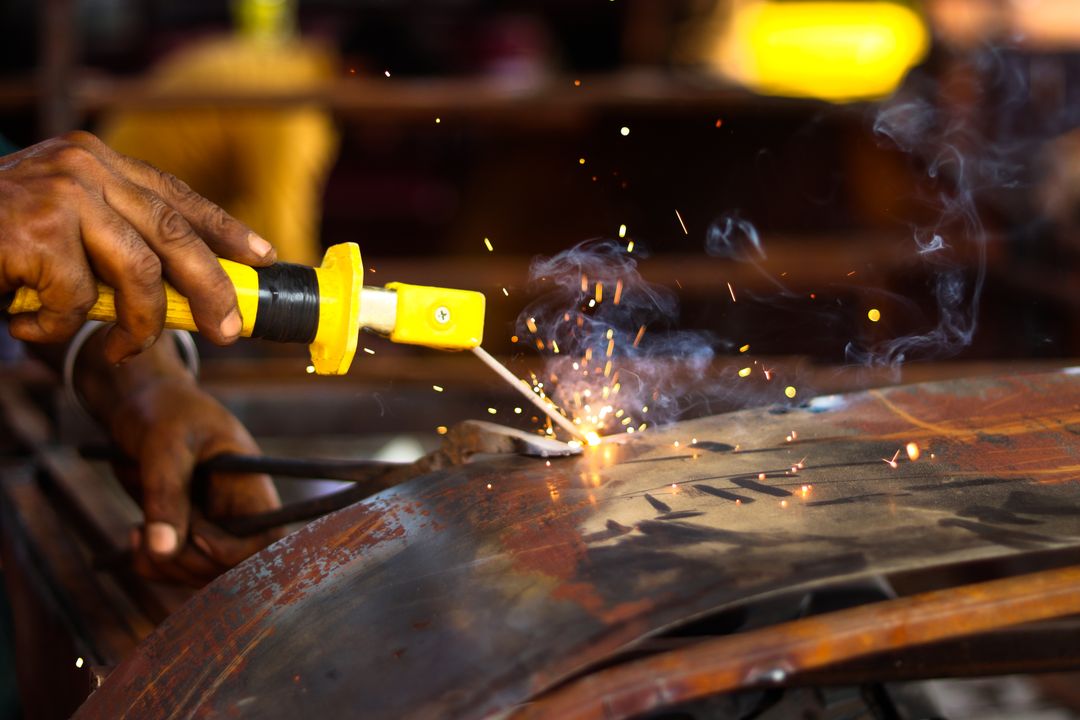
A channel-set or flush-set diamond band will survive most trades. A pavé band will not, and a job site is the fastest way to find out.
The stone is never the problem. Diamond is 10 on the Mohs scale and nothing you meet at work is going to scratch it. What fails is the metal holding it. Gold sits around 3 to 4 on the same scale depending on karat, and platinum around 4 to 4.5, so the beads and channel walls deform long before the diamond does. Once a bead flattens, the stone it was holding falls out somewhere you'll never find it.
Any ring with stones set into it also becomes harder to cut off in an emergency, and a stone-set band in a degloving injury is a worse outcome than a plain one. If you work around machinery, that's worth more thought than the sparkle.
For hard use, a solid band without stones is the answer, and we go through the trade-by-trade version of this in our guide for mechanics and construction workers.
Diamond band or plain tungsten: the honest comparison
We sell tungsten carbide and no diamond bands at all, so take the comparison below for what it is. The figures are the same ones any jeweler would quote you.
| Factor | Diamond band (gold or platinum) | Plain tungsten carbide |
|---|---|---|
| Band hardness (Mohs) | 14k gold about 3.5, platinum about 4 to 4.5 | About 9 |
| Density | 14k gold about 13 g/cm3, platinum 21.4 g/cm3 | 14.5 to 15.0 g/cm3 |
| Stones can be lost | Yes, and pavé most of all | No stones to lose |
| Resizing | Possible, but stones limit how far | Not resizable, exchange instead |
| Emergency removal | Cut with a standard ring cutter | Cracked off with vise grips |
| Common widths | 4mm to 8mm | 6mm and 8mm |
A tungsten band has no stones, so the ongoing risk of losing one is zero, and the maintenance is washing it. A diamond band buys you light that a plain band can't produce, at the cost of something that can come loose.
Tungsten carbide cannot be sized up or down, so an exchange is the route if your size moves. Every ring we make comes in 6mm and 8mm except Forge and Relic, which are 8mm only.
How to buy one without regretting it
Start with the setting, not the carat weight. Listings lead with ct tw because it's the number that justifies the price, and it tells you least about whether the ring lasts. Ask what the setting is before anything else, and if it's pavé and you work with your hands, move on.
Get the total stone count in writing. Replacement is quoted per stone, so a band with twenty-four tiny stones has twenty-four things that can go. Ask whether black stones are natural or treated, and get it on the receipt. Treated is fine and it's what most people are buying. Paying a natural price for a treated stone is not.
Check the return window against the wedding date. Men's ring sizing is less familiar territory than women's and the first size is often wrong, so a thirty-day window that expires before the ceremony is a problem you can avoid by asking.
If the stones turn out to matter less to you than the look, the alternative is an inlay rather than a setting. Nova uses a cosmic stone inlay set into black tungsten and Orbit does the same in a beveled profile. Neither has anything that can fall out. There is more on how inlays are held in our stone inlay buyer's guide, and the full black range sits in black tungsten rings and men's black wedding bands.
Common questions about men's diamond wedding bands
Do men actually wear diamond wedding bands?
Yes, and it is no longer unusual. Every major jeweler now runs a dedicated men's diamond band category, and the styles that sell are low-profile channel and flush settings rather than the raised stones used on engagement rings.
How many carats should a men's diamond wedding band be?
Most men's bands land between 1/10 and 1 carat total weight across the whole ring. Above that the stones start getting large enough to catch on things, which is the opposite of what a men's band is trying to do.
Can you put a diamond in a tungsten ring?
Not in the way a jeweler sets a stone in gold. Tungsten carbide is too hard to bend, so there are no prongs or beads to close over a stone. Rings sold as tungsten with diamonds use a groove or a bonded inlay instead.
Are black diamonds real diamonds?
Yes. Black diamonds are the same carbon crystal as white ones and sit at the same 10 on the Mohs scale. Most of the black stones sold in rings were originally included white or gray diamonds that were heat or irradiation treated to turn opaque.
What happens if a stone falls out of my wedding band?
A jeweler resets it, and the charge is per stone plus labor. Channel and flush settings lose stones rarely, while pavé beads flatten with impact and are the setting most often seen for this repair.
Is a diamond band or a plain band better for a groom?
It comes down to your hands. If you work with them, a plain band in a hard material means nothing to lose and nothing to maintain, and if you do not, a channel-set diamond band gives you light that no plain metal can.
If you want the look without anything that can come loose, our men's wedding bands are all nickel-bonded tungsten carbide in 6mm and 8mm, and a plain black band covers most of what men are reaching for when they shop black diamond.


