


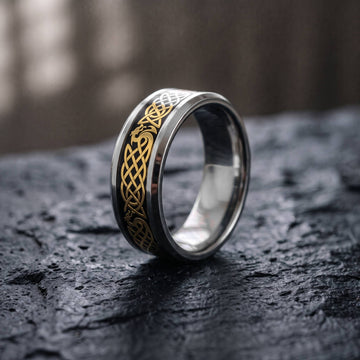
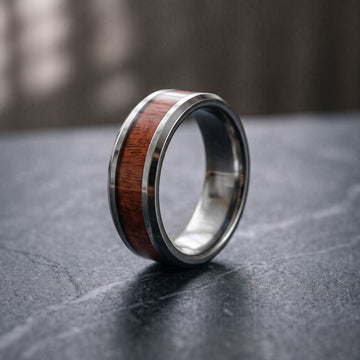
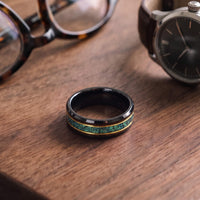
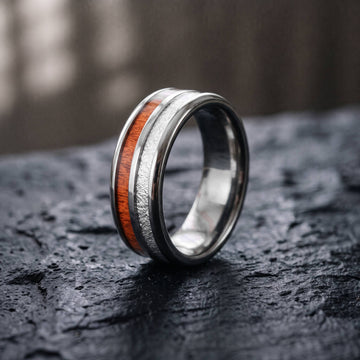
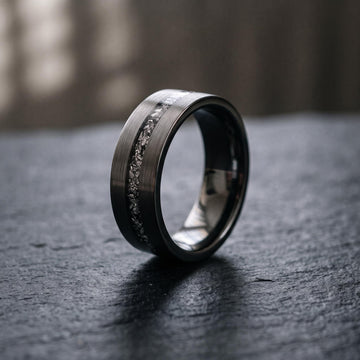

No, your ring size is not the same as your shoe size, and guessing one from the other is a gamble you do not need to take. The two scales measure different things in different units and step up in different amounts, so a size 10 shoe does not tell you that you wear a size 10 ring.
It matters more with tungsten than with gold, because a tungsten band cannot be resized later and a wrong guess means swapping the ring for another size.
If you are shopping for men's wedding bands, the size you pick decides whether you wear the ring every day or leave it in a drawer.
Is your ring size the same as your shoe size?
No, ring size and shoe size are two separate scales, and a man's number on one is not a reliable guide to his number on the other. It is possible to wear a larger shoe number than ring number, or the reverse, because nothing in either system ties the two together.
Where the numbers do land close, that is closer to coincidence than to a rule. Bigger men tend to have bigger hands and bigger feet, so the two sizes rise together across a crowd, but inside any one man the pairing is loose. Foot length is what a shoe size follows, and foot length says nothing about the width of your knuckle or how much your fingers swell, which are the two things that decide whether a ring slides on and stays put.
How are ring sizes and shoe sizes measured differently?
A US ring size is the inside diameter of the ring, while a US shoe size is the length of the shoe, and the two step up in very different amounts. Each full ring size adds about 0.8 mm of inside diameter, and each full shoe size adds a third of an inch of length, which is about 8.5 mm.
A ring size 10 has an inside diameter of 19.8 mm, and a ring size 11 has 20.6 mm, a difference you would barely see on a ruler, while one shoe size moves about 8.5 mm, so the numbers cannot be swapped.
| Feature | Ring size | Shoe size |
|---|---|---|
| What it measures | The inside diameter of the ring | The length of the shoe |
| Step between full sizes | About 0.8 mm of inside diameter | One third of an inch, about 8.5 mm, of length |
| Body part it depends on | The base of the finger and the knuckle the ring must clear | The foot from heel to toe |
| Effect of width | A wide band fits tighter than a narrow one in the same size | Width is given separately from length |
| Adjusting a bad fit | Not possible on tungsten, so you swap for another size | Laces, insoles and thicker socks |
A shoe that is a little off can be fixed with an insole, but a ring that is a little off is simply the wrong ring.
Why do people think ring size and shoe size match?
The belief comes from an old rule of thumb that hands and feet scale together, and from the fact that both sizes are single numbers that look alike. Some men do have a shoe size and a ring size close together, and one lucky match is enough to turn a coincidence into advice.
The shortcut survives because it feels useful when you have nothing else to go on. It can work as a rough sanity check, a way to notice that a measured size looks far out of line, but no chart converts shoe size to ring size, because the two systems do not measure the same part of the body in the same way.
Can your shoe size help you guess your ring size?
Only as a last resort, and a US 10 is a better blind guess than your shoe size. Our guide to the average men's ring size puts the most common men's size at 10, with most men landing between 9 and 11.
If you are buying a ring for someone else and cannot ask, skip the shoe size entirely. The better move is to borrow a ring he already wears on the right finger and measure its inside diameter, which our surprise wedding band guide walks through step by step. A measured ring beats any shortcut, and it takes a few minutes.
What should you use to find your real ring size?
A printable ring sizer, a ring you already own, or a paper strip wrapped around the base of your finger will all beat a shoe-size guess. They are listed here in order of accuracy, and the full walkthrough for each is in our guide to measuring men's ring size at home.
The most accurate home option is a printable sizer, set to print at 100 percent scale so the markings are true. Second is a ring that already fits the right finger comfortably. Lay it flat, measure the distance across the inside in millimeters, and match the number to the chart below. Third is the paper or string strip, which works in a pinch but is easy to pull too tight or too loose.
| US ring size | Inside diameter | Inside circumference |
|---|---|---|
| 8 | 18.1 mm | 57.0 mm |
| 9 | 19.0 mm | 59.5 mm |
| 10 | 19.8 mm | 62.1 mm |
| 11 | 20.6 mm | 64.6 mm |
| 12 | 21.4 mm | 67.2 mm |
Whichever method you pick, measure late in the day when your hands are at their normal temperature. Fingers shrink in the cold and swell in the heat, and a reading taken first thing on a cold morning can leave you with a ring that will not come off in July. For half sizes and UK and EU conversions, use our men's ring size chart.
Does band width change the ring size you need?
Yes, a wide band covers more of your finger and fits tighter than a narrow band in the same size, so a size you measured with a thin sizer can feel snug in an 8mm ring. A shoe size has no equivalent of this problem, which is another reason the two do not translate.
The usual advice is to go up a quarter to a half size when you move to a wide band. A comfort fit band, which is rounded on the inside, slides over the knuckle more easily and can change the math again, and our guides to 6mm vs 8mm ring width and comfort fit vs standard fit cover both in detail. If you want to try a narrower profile first, Monolith comes in 6mm and 8mm, so you can compare widths in the same style.
What happens if you guess your ring size wrong?
With tungsten, a wrong size means exchanging the ring for the right one, because a tungsten ring cannot be resized the way a gold band can. Our guide on whether you can resize a tungsten ring explains why, and it is the main reason to measure instead of guessing.
If your measurement falls between two sizes, size up rather than down, especially for a wide band. A ring that is a touch loose can be managed, while one that will not pass the knuckle cannot be worn at all. For how sizing, exchanges and returns work when you order a band online, see our guide to buying a wedding band online, and for the feel you are aiming for once it is on, read how a ring should fit.
Common questions about ring size and shoe size
Is ring size the same as shoe size?
No, ring size follows the inside diameter of the ring, while shoe size follows the length of the shoe, and each full size on the two scales covers a very different distance. Some men have numbers that land close together, but that is coincidence and not a rule.
What ring size is a size 10 shoe?
There is no conversion, because the two scales are not linked. A US 10 happens to be the most common men's ring size, so it is a reasonable blind guess when you have nothing else, but a measurement will always beat it.
Can you use your shoe size to buy a wedding band online?
It is not a safe way to choose a size. Measure the finger with a printable sizer, a ring that already fits or a paper strip, because tungsten cannot be resized if the guess turns out wrong.
How do you find a man's ring size without asking him?
Borrow a ring he already wears on the right finger and measure its inside diameter in millimeters, then match that number to a ring size chart. This works only if the ring fits him well, so skip one that spins or sticks on the knuckle.
Should you size up for a wide band?
Usually yes, since a wide band fits tighter than a narrow one in the same size, so many men go up a quarter to a half size for an 8mm ring, and anyone between sizes should round up instead of down.
Are men's and women's ring sizes the same?
They use the same scale, so a size 9 is a size 9 for anyone. Men's fingers run larger on average, which is why men's rings cluster at the higher end of that scale, and our guide on men's and women's ring sizes shows how the two compare.
Once you have a measured size, browse our tungsten rings to compare widths and profiles, and look at Ingot if you want a classic, simple band to start with.


