
Most people think a personalized men's ring is just an engraving on the inside. While it is certainly something worth doing, an engraving is one of five elements of personalization with varying degrees of impact. In fact, it tends to be the only one of the five that men think of as personalization at all. Other factors, such as the material on the outside, the way the surface is finished, the color inside the band, and the ring's width, all affect how the ring presents itself to you and to everyone else who looks at your hand. Tungsten adds a constraint that gold does not have, because none of these choices can be reversed once the ring is made. This guide explains how all of these elements function, who actually notices them, and the order of importance for determining your personalization.
What does a personalized men's ring actually mean?
If you search for a personalized men's ring, the vast majority of the results will be related to engraving. This is the narrowest possible definition of the term. In reality, personalization on a men's band is five distinct choices, and they work at different distances.
Engraving works at arm's length, which in practice means it works when the ring is off your finger. An inlay works from across a room. A finish works somewhere between the two, and it is the thing most people register first without being able to name it. Interior color is private, visible to you and to whoever put the ring on your finger. Width is the loudest of the five and almost nobody counts it as personalization, which is strange, because it changes the look of a hand more than any engraved line ever will.
The useful way to think about this is not which option is best. It is which distance you care about. A man who wants his ring to say something to him picks engraving. A man who wants his ring to look unlike the four other bands at the table picks inlay or finish. Those are different goals and they lead to different rings.
Can you engrave the inside of a men's ring?
Every ring in the FoundryCut catalog can be laser-engraved on the interior. Tungsten carbide is too hard for a rotary graver, so the work is done with a fiber laser that cuts the surface rather than pushing metal aside. The result sits below the surface of the band and stays legible under normal wear.
The practical limit is space, not technique. On a 6mm band you have room for roughly 20 to 30 characters, which covers two first names, a date, or a short phrase. On an 8mm band that rises to around 30 to 45 characters, enough for a short line of a quote or a set of coordinates. Those numbers include spaces, and they shrink if you ask for a larger font or line art alongside the text.
What people engrave falls into predictable groups. Dates, initials, coordinates, a line from vows, a phrase that means nothing to anyone outside two people. Our guide to wedding ring engraving ideas works through the wording in detail, and the piece on what tungsten engraving can and can't do covers the mechanics, including which fonts survive at that size and which ones turn into a smudge.
One thing worth knowing before you commit. A plain interior gives the cleanest result, so a matte silver band like Ingot or a black matte band like Monolith reads more sharply than a ring whose interior already carries a second color.
What is an inlay on a ring?
An inlay is a channel cut into the band and filled with something that is not tungsten. Wood, antler, stone, carbon fiber. It is the only personalization on this list that changes what the ring is made of rather than how it looks.
Natural materials carry an argument the others don't. Grain, figure and color vary from one piece to the next, so two rings built to the same spec will not match each other exactly. If you want a ring that is specifically yours rather than one of a run, that variation is the closest thing to it without commissioning a piece from scratch. Hearth uses antler against a rose finish, and Rift pairs a matte body with wood or stone in a flat profile. The full set sits in the inlay and natural rings collection.
Synthetic inlays work the other way around, because carbon fiber and stone composites are consistent piece to piece, and that consistency is the point of them. You are choosing a look rather than a one-off. Neither approach is better than the other, since they answer different questions, and it helps to know which question you are asking before you start comparing product photos.
Finish changes how the ring reads at distance
Finish is the least discussed and most visible choice on a men's band. It decides what the metal does with light, and that is the first thing anyone registers about a ring from six feet away.
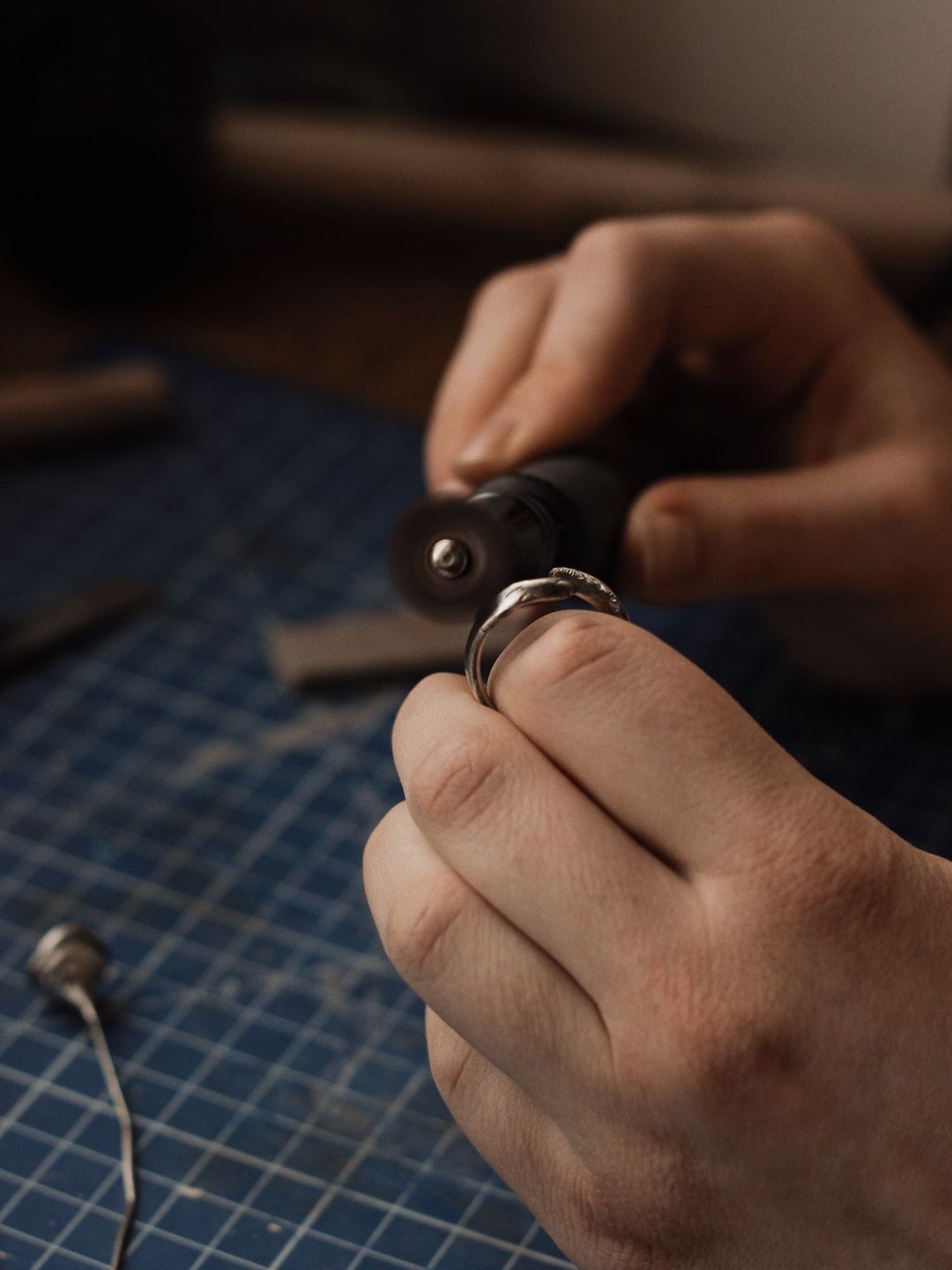
A matte or brushed surface reads flat and low-gloss, closer to tool steel than to jewelry. Polished throws light and looks more traditional. Hammered breaks the surface into facets that catch light at different angles, so the ring never looks like one flat plane. Forge and the rest of the hammered rings sit at that end, and they behave very differently on a hand than a smooth band of the same width does.
Profile compounds all of that. A beveled edge cuts a hard line around the rim and makes the band look narrower than it measures. A domed band curves across its whole width and reads softer and slightly wider. A stepped band adds a shoulder that catches a second highlight. Two men wearing the same 8mm ring in the same color can end up with rings that look nothing alike, purely on finish and profile.
Interior color and two-tone detail
Having a colored interior is one of the quietest and most surprising forms of personalization. From the outside, the ring looks like a plain band of black or silver, but when you turn your hand, there is rose gold, gold, or blue on the inside.
Helm has a black matte exterior and a rose gold interior, and Halcyon uses blue inside a gold domed band. If you want the second color to be more subtle, the two-tone rings contain the second color on the outside as a stripe or edge.
There is a practical trade-off. A colored interior competes with engraving for the same surface, so if you want both, keep the engraved line short and expect it to sit against a colored background rather than a plain one. Deciding which of the two matters more to you is easier now than after the ring arrives.
Width and profile are personalization too
Width does more to the look of a hand than anything else on this list, and it is usually treated as a sizing footnote. A 6mm band on a broad hand disappears. An 8mm band on a slim hand takes over. Neither is wrong, but the choice is aesthetic long before it is technical, and it deserves the same attention as the finish.
Most FoundryCut styles come in 6mm and 8mm, so the same design can go either way. Our breakdown of 6mm versus 8mm ring width covers how each wears day to day. Width also interacts with fit, because a wider band sits against more of your finger, and that is where the difference between a comfort fit and a standard fit starts to matter.
Engraving space is tied to width as well, which is the one place these decisions collide. Choosing a 6mm band and then asking for a 40-character inscription does not work. Pick the width for the hand, then write to the space you have.
How the five choices compare
Laid side by side, the five options separate cleanly on two questions. Who sees it, and whether you can change your mind later.
| Choice | What it changes | Who sees it | Changeable later |
|---|---|---|---|
| Interior engraving | Text or simple line art inside the band | You, when the ring is off | Can be added later, permanent once cut |
| Inlay material | What the outside of the ring is made of | Everyone, from across a room | No, set when the ring is built |
| Surface finish | How the metal handles light | Anyone within a few feet | No, chosen at purchase |
| Interior color | A second metal tone inside the band | You, and whoever looks closely | No, built into the ring |
| Width and profile | How much of the finger the ring covers | Everyone, first thing they notice | No, and it is tied to your size |
Four of the five are locked at purchase. That is the honest headline of this table, and it is why the decision order in the last section matters more on tungsten than it would on gold.
What can't you change afterwards?
Tungsten carbide is not resizable. A jeweler can neither stretch nor compress the band, which means a ring that no longer fits cannot be altered, and must therefore be replaced. Our article on whether a tungsten ring can be resized goes through what that means in practice and why it is less of a problem than it sounds.
The consequence for personalization is direct. Size sits underneath every other choice on this page, because getting it wrong undoes all of them at once. A carefully chosen inlay, finish and inscription are worth nothing on a band you can't wear, so the measuring comes first. If you have not sized properly, the walkthrough on measuring your ring size at home takes about ten minutes and removes the only decision here that can't be worked around.
The second most constraining decision is engraving. It can be added after the ring is made, but it cannot be removed or rewritten, so the test isn't whether the wording feels right this month. It is whether it will still feel right in fifteen years, when the reference has aged along with everything else.
The order to decide in
Work from the decision that constrains the most other decisions down to the one that constrains none.
- Size, because it can't be corrected later and everything else depends on it.
- Width, because it drives both the look on your hand and how much engraving space you have.
- Material and finish, because they decide what the ring says at a distance.
- Interior color, if you want a detail that only you know is there.
- Engraving last, once the width is settled and you know what fits.
Most men do this in reverse. They arrive with a phrase they want engraved, choose the ring that looks closest to the photo they saw, and discover at checkout that the phrase runs to 52 characters. Deciding in the order above costs nothing and removes that whole conversation.
If you are starting from zero, the signature collection is a good place to begin. Take a look at how the different finishes, profiles, and inlays can change the appearance of a simple band. Then work backwards to the version that fits your hand and your wording.
Common questions about personalized men's rings
What counts as a personalized men's ring?
This refers to any ring where you select something other than the size. That includes interior engraving, an inlay material such as wood or antler, the surface finish, a colored interior, and the width of the band. Engraving is the most popular answer, but the other four change the look of the ring more.
Can a tungsten ring be engraved?
Yes. Tungsten carbide is too hard for a traditional rotary graver, so the work is done with a fiber laser instead. Every ring in the FoundryCut catalog can be laser-engraved on the interior with text or simple line art.
How many characters fit inside a men's ring?
On a 6mm band, roughly 20 to 30 characters including spaces. On an 8mm band, roughly 30 to 45. A larger font or added line art reduces both figures, so it is worth settling the width before you finalize the wording.
Can you add engraving to a ring you already own?
Since engraving does not alter the shape of the band, it can be added after purchase. However, engraving is permanent and cannot be removed or rewritten. Think of the wording as a permanent decision rather than a reversible one.
Can an inlay be swapped for a different material later?
No. The inlay sits in a channel cut into the band during manufacturing, and it is set when the ring is built. If you think you might want a different material, choose it now rather than planning to change it.
Which personalization decision should I make first?
Your size, because you can't resize a tungsten ring, and a ring that doesn't fit makes every other choice irrelevant. Width comes second, since it controls both the look on your hand and how much engraving will fit.
Personalization on a tungsten band is a set of decisions you make once. Get the size and the width settled first, choose the finish and material that match how you actually want the ring to read, and save the wording for last. Browse the men's wedding bands and start with the one you would still pick if nothing were engraved on it.


