
The wedding ring sits on the left hand because the ancient Romans believed a single vein, which they called the vena amoris, or "vein of love", ran from the fourth finger of the left hand directly to the heart. That belief turned out to be anatomically wrong, and there is no such vein. But the tradition stuck for two thousand years, was reinforced by the Christian church in the medieval period, exported globally during European colonial expansion, and is now the default in nearly every Western country and many Eastern ones. The real story of why the wedding ring is on the left hand is part bad anatomy, part smart marketing, part inertia, and it's more interesting than the romantic version usually told. Here is how the tradition actually evolved.
Why is the wedding ring worn on the left hand?
The earliest known reference to the wedding ring on the fourth finger of the left hand comes from the Roman writer Aulus Gellius in the 2nd century AD. He cited an even older Egyptian belief that this finger contained a "delicate nerve" running directly to the heart. The Romans adopted and romanticized the idea, calling the vessel the vena amoris. A ring placed there, the thinking went, would symbolically encircle the bond between two lovers' hearts.
It is a beautiful idea. It also has zero anatomical basis. The blood vessels in your fourth finger are identical in structure to the vessels in your other fingers. Each connects to the same general circulatory loop, and none of them connects "directly" to the heart in any meaningful sense.
But the myth was repeated by Roman scholars, then Christian theologians, then medieval physicians, for so long that nobody bothered to dissect a hand and check until well into the Renaissance. By then, the tradition was so embedded in marriage ceremonies across the Roman Empire's former territories that the anatomical correction came too late to matter.
Is there really a vein running from the ring finger to the heart?
The fourth finger of the left hand is served by the same three main vessels as every other finger:
- The palmar digital arteries, which branch off the ulnar and radial arteries
- The dorsal digital veins, draining back into the dorsal venous network of the hand
- The palmar digital nerves, from the median and ulnar nerves
None of these structures behaves differently in the fourth finger than in any other. There is no special connection to the heart, no "vein of love," no anatomical reason this finger is more significant. The wedding ring tradition outlived its scientific premise by more than 500 years before anyone noticed.
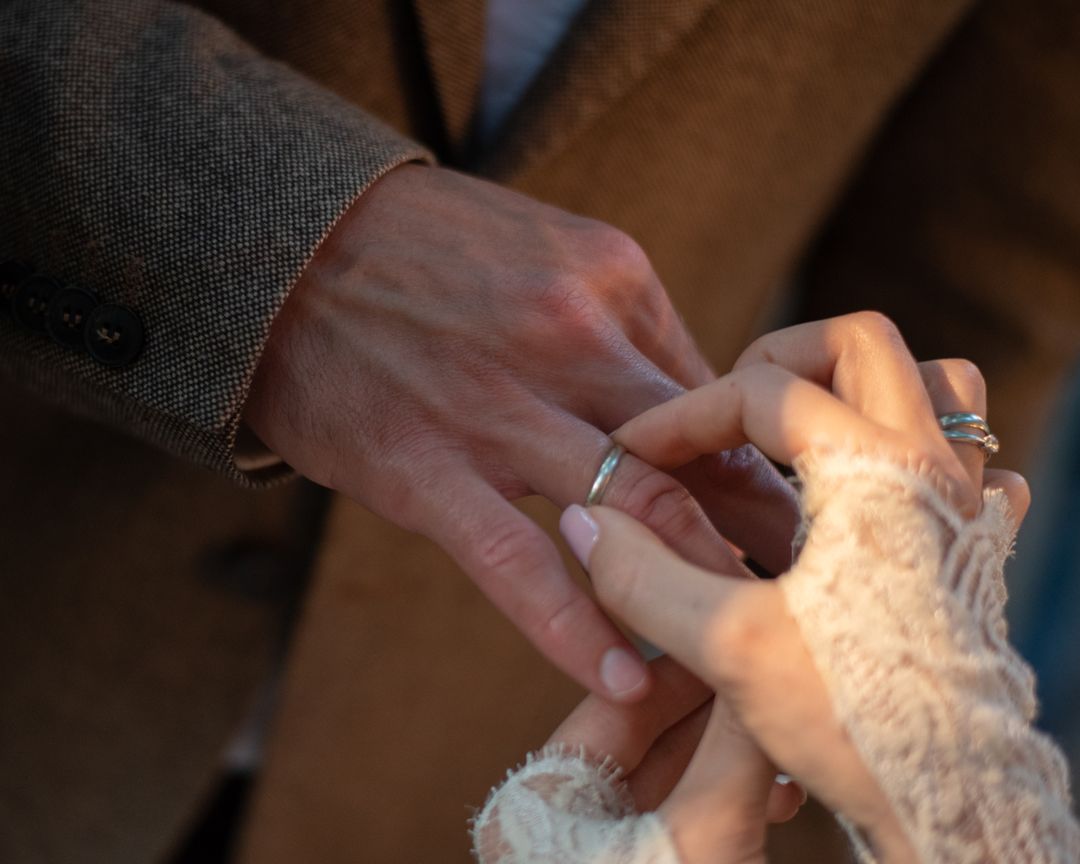
How did the Christian church lock in the tradition?
The Roman custom became Christian custom in the 4th century, when Christianity went from persecuted sect to imperial religion. Bishops adopted the existing Roman betrothal ritual, including the ring on the fourth finger of the left hand, and built it into the Christian wedding rite.
A few centuries later, in the medieval Catholic ceremony, the priest would touch the wedding ring to the bride's thumb, index finger, and middle finger in turn, naming the Father, the Son, and the Holy Spirit, before finally sliding it onto the fourth finger. The fourth finger was specifically the "marriage finger." This three-finger blessing was carried into the Protestant Reformation largely unchanged in the English-speaking world.
From there, the left-hand tradition spread through every country with significant European Christian influence, meaning most of the Western Hemisphere, parts of Africa, the Philippines, and (through British colonial influence) India, Australia, and the rest of the Anglosphere.
Why we still wear it there despite knowing better
The vein of love being a myth is now common knowledge, and any high school biology textbook will confirm there is no special connection between that finger and the heart. So why has the tradition outlasted its premise?
The first reason is cultural inertia. Wedding rings are one of the longest-running social conventions in the Western world. Each generation watched their parents wear the ring on the left hand and reasonably assumed there was a reason. By the time anyone checks, they're getting married themselves and not particularly motivated to break with their grandparents' tradition.
The second is practical convenience. Most people are right-handed (about 90%), and wearing the ring on the non-dominant hand means it gets less abuse: fewer scrapes against handles, fewer accidental hits when reaching, less wear from constant manipulation. Even if you'd never heard the vein-of-love story, the left hand makes practical sense for the average right-hander.
The third is coordinated meaning. Once everyone in your culture wears their ring on the left, the visible signal of "married" only works if you join them. A ring on the right hand reads as something else: a class ring, a signet, or a piece of jewelry, depending on the country. The point of a wedding ring is recognizability, and recognizability requires conformity. That signal is only one layer of what a wedding ring symbolizes, which is worth knowing before you decide which hand it goes on.
Which countries wear the wedding ring on the right hand?
The left-hand tradition is far from universal. About a third of the world's married couples wear their wedding rings on the right hand, including:
| Country / Region | Default hand | Reason |
|---|---|---|
| United States, UK, Canada | Left | Roman / Christian tradition |
| Germany, Austria, Hungary | Right | Lutheran tradition reversed it, and "right" is dexter, the favored side |
| Russia, Greece, Eastern Europe | Right | Orthodox Christian tradition |
| India (Hindu) | Right | Left hand is considered ritually unclean |
| Brazil, Colombia, Venezuela | Right | Iberian Catholic tradition, engagement ring on left, wedding band on right |
| Mexico, most of Latin America | Left | Roman Catholic tradition, same as the US |
| China, Japan, Korea | Left | Adopted from Western tradition in the 20th century |
For American men, the default is unambiguously left, and that's true whether your background is Roman Catholic, Protestant, secular, or anything else. The right-hand custom is something American grooms only need to think about if their in-laws come from a country in the right-hand column, or if they want to break tradition deliberately.
The practical case for the left hand
Stripped of the mythology, there's a still-valid argument for the left hand:
- There is less wear and tear, because your non-dominant hand does less work. The ring takes fewer hits, picks up less dirt, and avoids constant manipulation. Even a tungsten ring, which resists everyday scuffs, appreciates being on the less-active hand.
- There is lower snag risk, because the dominant hand reaches more, grips more, and is more likely to catch a ring on something while you work. A ring on the left hand has fewer chances to get caught.
- It is easier to remove for handwashing, since your right hand can fluently take a ring off the left and replace it. The reverse is awkward for most people.
- It is easier to wear with a watch, because most men wear a watch on the left wrist by default. A wedding ring on the left hand pairs visually with the watch, both visible together when you check the time.
For most American grooms, the answer is: wear it on the left hand because tradition says so, and the tradition happens to also be the practical choice. The Roman myth was wrong, but their conclusion still works.
For a deeper look at which hand and finger to use across countries and religions, see our companion piece on which hand men wear a wedding ring on. When you're ready to pick the band itself, Monolith and Ingot are our bestselling left-hand-friendly tungsten options, and both come in widths that pair well with a watch. Or browse the full men's wedding bands collection to see the range.
Common questions about the left-hand tradition
Is the wedding ring really supposed to be on the left hand?
In the United States, yes, by tradition. The custom dates back to ancient Roman beliefs about a vein running from the fourth finger of the left hand to the heart. The anatomy is false but the convention has held for two thousand years.
Why the fourth finger specifically?
The Romans designated the fourth finger as the location of the symbolic "vena amoris." The Christian church then formalized the fourth finger as the marriage finger through the three-finger blessing ritual in the medieval ceremony.
What does it mean if a man wears his wedding ring on the right hand?
In the US, it usually means he's from or has roots in a country where the right hand is traditional: Germany, Russia, Greece, Eastern Europe, or some Latin American countries. It can also signal a deliberate non-traditional choice. Some widowed men move the ring to the right hand after losing a spouse.
Can I wear my wedding ring on whichever hand I want?
Yes. There is no legal or religious requirement to wear it on the left. The only argument for following tradition is recognizability, since most Americans read a ring on the right hand as something other than a wedding band.
Why is the engagement ring on the same hand as the wedding band?
By tradition, both go on the fourth finger of the left hand in the US, engagement ring first, then the wedding band placed inside it (closer to the palm) at the ceremony. This is the same Roman-derived custom. The engagement-then-wedding stacking developed in the late 1800s when diamond solitaires became common.
The vein of love is a myth, but it's the myth that's outlasted the people who debunked it. The wedding ring stays on the left hand because two thousand years of tradition, paired with a few real practical advantages, kept it there. If you're picking out a band of your own, the FoundryCut best sellers are designed for exactly this kind of long-haul wear, built to sit on a left hand for the next several decades.


