
A domed wedding band curves on the outside. A beveled band has angled edges that frame a flat top. A flat band is a clean rectangle, edge to edge. Three profiles, three completely different rings, and most guys pick one without realizing they had a choice. Profile shapes how the ring sits on your finger, how it catches light, how it feels under a glove, and how visible the band looks from across a table. This is a long-term decision dressed up as a small one. Below: what each profile actually is, who it suits, and which FoundryCut bands carry each shape.
What "Ring Profile" Actually Means
Profile is the cross-section of the band. Slice the ring in half with a wire saw, look at the cut end face-on, and the silhouette you see is the profile. Width and thickness are separate measurements that describe how big the ring is; profile describes the shape of that material.
There are three dominant profile families in men's wedding bands today: domed, beveled, and flat. Each one has a distinct visual signature, a distinct feel against the adjacent fingers, and a distinct reputation. A jeweler doesn't think "wide" or "narrow" first; they think "domed or beveled" first, because that single decision sets the tone of the entire ring.
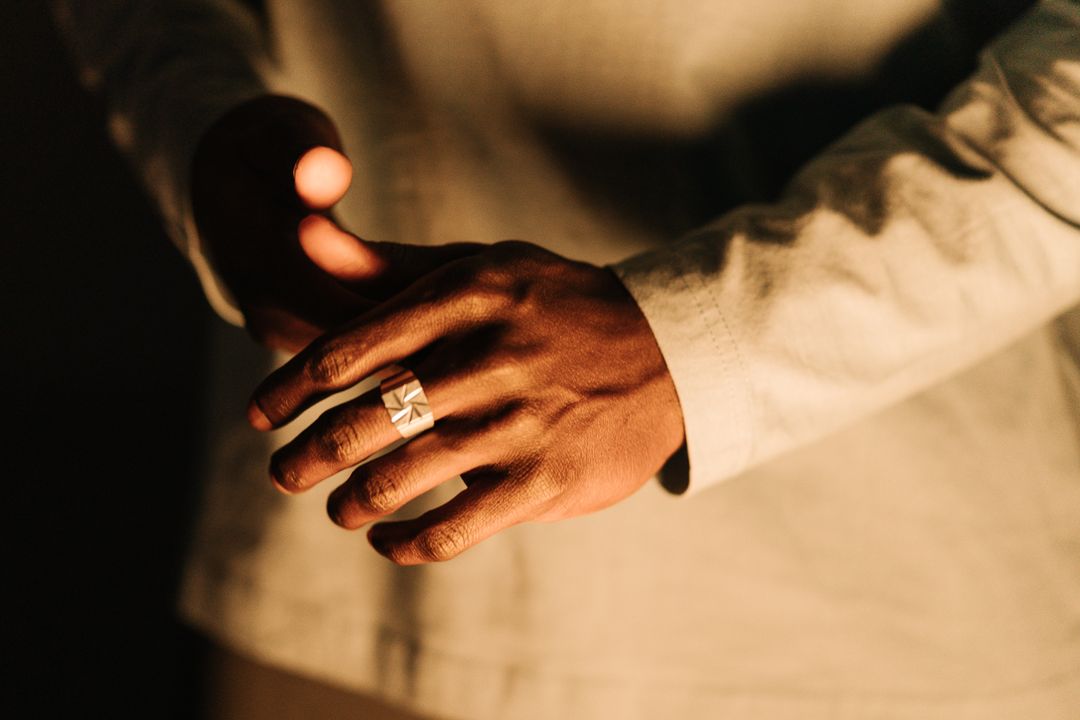
What follows is each profile broken down to the level your jeweler would explain it if they had time, plus where each one lives in the FoundryCut catalog. Profile is the cheapest decision you make about a ring (it costs nothing to pick one over another), but it's also the one you can't change later without buying a new band.
Domed Wedding Bands: The Curved Comfort Pick
A domed wedding band has a continuously curved outer surface. There are no edges, no facets, no straight lines visible from the side; just a smooth arc that rises from one edge of the band, peaks at the center, and falls back down to the opposite edge. From the top, the ring still reads as a band, but the curve catches light along a continuous strip rather than at sharp lines.
The defining feature isn't the dome itself, it's what the dome removes. There are no corners to dig into adjacent fingers when you make a fist. The band rolls slightly as your hand moves, instead of locking against the skin at an edge. Guys who wear gloves at work, grip tools all day, or hold a steering wheel for long stretches almost always feel the difference within an hour of wearing a domed band versus a flat one.
Domed profiles also photograph differently. Light hits the curve as a soft gradient instead of a hard line, which makes the band look slightly more polished even when the finish is matte. That's part of why curved bands feel more traditional to older eyes; the silhouette is closer to the classic gold wedding bands of the 1950s and 60s than to the squared-off industrial look of modern tungsten.
Worth knowing: domed bands almost always read as the most comfortable profile, but they can also look slightly less assertive than beveled or flat alternatives. If you want the ring to disappear into your hand and just be present, dome. If you want it to show up in photos and read as a deliberate object, beveled or flat is a better pick.
In the FoundryCut catalog, the Halcyon is the cleanest example: a gold matte domed band with a blue interior, curved comfort fit, no edges anywhere. The Reign takes the same profile in black matte with a gold interior, and the Nova applies the dome to a cosmic-stone-inlay statement band. For more options, the full domed rings collection shows what shapes feel like in person.
Beveled Wedding Bands: The Modern Default
A beveled wedding band has a flat top surface, with the outer edges angled inward at roughly 45 degrees down to the bottom edge. From the side, the cross-section looks like a trapezoid with the long side on the inside of the ring. Those angled cuts are the "bevels," and they're the single most defining feature of contemporary men's wedding bands.
Most modern men's tungsten rings ship with bevels by default. They have been the dominant profile in men's bands since roughly the early 2000s, which is when tungsten carbide first became affordable enough to challenge gold for everyday wedding rings. The reason is mostly visual: the bevels create two extra surfaces that catch light, so a single ring shows three distinct planes (top flat, two angled bevels) instead of one continuous curve. That gives a beveled band more visual structure and a more deliberate, designed look than a smooth dome.
Beveled rings are also the easiest profile to play with finish-wise. A common spec is a brushed flat top paired with polished bevel edges, which creates a frame effect around the top of the ring. The contrast makes the bevels read as accents instead of just structural cuts. Most of the FoundryCut catalog uses some version of this two-tone-finish strategy. If you want to push the two-color story further than just bevels — pairing silver with rose gold, or black with a gold interior — the two tone wedding bands guide walks through every pairing and how each construction method reads on the hand.
The trade-off for that visual interest is feel. The bevel-to-bevel transition still has a corner, even if it's softened. Guys with very dense finger packing (think large hands with closely spaced fingers) sometimes notice the adjacent finger catching the bevel edge when they form a fist. For most hands this is a non-issue, but it's why some buyers cross-shop beveled and domed before committing.
Beveled is the workhorse of the FoundryCut catalog. The Monolith is the bestseller: black matte top, polished bevels, available in 6mm and 8mm. The Ingot is the silver matte counterpart, the cleanest beveled profile we make. The Helm adds a rose gold interior to the black beveled silhouette, and the Tide brings in a blue inlay accent. The beveled rings collection is where most guys start the catalog.
Flat Wedding Bands: The Architectural Choice
A flat wedding band is exactly what it sounds like: the outer surface is a single flat plane from one edge to the other, and the edges meet that plane at a near-90-degree angle. The cross-section is a rectangle. There are no bevels, no curves, no transitions; just a rectangular ring of metal sitting on the finger.
This is the most architectural of the three profiles. A flat band reads as deliberate and minimal in a way that beveled and domed bands don't. The lack of bevels actually makes the ring look wider at the same physical width, because the eye sees the full top surface uninterrupted by angled cuts. A 6mm flat band looks about as broad on the finger as a 7mm beveled band.
The architectural quality is the appeal. Flat profiles came back into men's wedding bands in the 2010s as a reaction to the heavy beveled aesthetic that had dominated for a decade. They pair particularly well with modernist aesthetics, monochrome wardrobes, and guys who lean toward Bauhaus over baroque. If your watch is a Nomos rather than a Rolex Submariner, a flat band is probably the right pick.
The feel is the trade-off. A flat band has the hardest edges of the three profiles, so it can feel more "present" against the adjacent fingers, especially when gripping. Comfort fit on the inside surface mitigates a lot of this (the inside is rounded even though the outside is flat), but a flat band will never feel as edge-free as a dome.
In the FoundryCut catalog, the Seam is the entry point: black or silver matte, flat profile, the most minimal silhouette we ship. The Rift uses the same flat profile but adds a wood or stone inlay running the length of the band, which makes the flat top read as a canvas instead of just an absence of detail.
Profile at a Glance: Side-by-Side Comparison
Each profile shapes the same five buying questions differently. The table below is the cheat sheet most guys actually want when they're cross-shopping.
| Trait | Domed | Beveled | Flat |
|---|---|---|---|
| Silhouette | Smooth curve, no edges | Flat top with angled edges | Rectangular, edge to edge |
| Visual feel | Soft, traditional, gradient | Modern, framed, deliberate | Minimal, architectural, bold |
| Perceived width | Reads slightly narrower | Reads at true width | Reads slightly wider |
| Edge feel | No edges; rolls in fist | Softened bevel edge | Sharpest edge; most present |
| Best for | Manual work, classic taste | Most guys, most lifestyles | Modernists, statement seekers |
| Catalog example | Halcyon, Reign, Nova | Monolith, Ingot, Helm | Seam, Rift |
How to Choose: Matching Profile to Hand and Lifestyle
The honest answer is that any of the three profiles will work for any hand. Profile is a preference, not a fit problem. But there are patterns that hold up across thousands of orders, and they're worth knowing before you commit.
Pick domed if you do anything physical with your hands. Mechanics, electricians, carpenters, climbers, weightlifters, ranchers, surgeons, anyone who wears gloves regularly. The edgeless curve means there is no corner to dig into adjacent fingers or catch on glove liner when you flex. It's also the right pick if your idea of jewelry is "I shouldn't notice it." See the trade-specific guide if your job is the deciding factor.
Pick beveled if you want the default modern men's band. Beveled is the right answer for the largest set of buyers. It looks deliberate without being loud, it photographs well in any setting, and it works with every wardrobe from a suit to a flannel. If you're cross-shopping and can't decide, beveled is the lowest-regret choice; it's the profile that the broadest audience reads as "obviously a wedding ring."
Pick flat if you want the ring to be a design object. Flat profiles are for guys who think about what they wear. They pair with modernist watches, minimal wardrobes, and a taste for the architectural. They also work as canvas profiles for inlay (wood, stone, antler), because the flat surface gives the inlay room to be the visual subject instead of competing with bevel structure.
Hand size matters less than lifestyle. A wide hand with thick fingers can wear any profile; a slim hand with long fingers can also wear any profile. What changes is the perceived width: a flat profile on a slim finger reads broader and more dominant than a domed profile of the same physical width. If you have slim fingers and want a band that reads sized to the hand, you may want a narrower flat profile (6mm) or step up to a wider domed profile (8mm).
Profile vs Comfort Fit: Don't Confuse the Two
This is the single most common confusion in men's wedding ring shopping. Profile and comfort fit are different things. They describe different surfaces of the ring.
Profile is the outside. Domed, beveled, or flat describes the shape of the outer surface, which is what the world sees and what you photograph.
Comfort fit is the inside. A comfort-fit ring has a slightly rounded inner surface instead of a flat 90-degree-angle inside. The rounded interior means less surface area touches the skin, which makes the ring easier to slide on, easier to slide off, and more tolerant of mild finger swelling on hot days or after exercise.
A ring can have any combination of profile and fit. A flat-profile ring can have either a comfort-fit or a standard-fit interior. A domed ring almost always pairs with comfort fit because the manufacturing is similar, but a beveled ring can go either way. Every FoundryCut band ships with a comfort-fit interior regardless of outer profile. For a deeper breakdown, see the comfort fit vs standard fit guide.
FoundryCut Picks by Profile
If you've narrowed to a profile and want the shortest path to a specific ring, here's where to start.
Domed picks: The Halcyon (gold matte with blue interior, the cleanest dome we make) is the go-to if you want a domed band that doesn't lean traditional. The Reign (black matte with gold interior) is the dome for guys who want a darker, more contemporary read. The Meld and Nova bring the dome into inlay territory if you want texture as well as curve.
Beveled picks: The Monolith (black matte, 6mm or 8mm) is the bestseller of the entire FoundryCut catalog for a reason; it's the most versatile beveled silhouette we ship. The Ingot is the silver version, equally clean. The Helm adds rose gold to the inside, the Tide adds a blue inlay, the Crest adds a gold inlay, and the Beacon adds blue with a beveled twist. If you want the catalog's center of gravity, this is where it lives.
Flat picks: The Seam is the minimal flat band in black or silver matte. The Rift is the same flat shape with a wood or stone inlay running the length of the top. For a stepped variation on flat, the Pillar adds a single step that creates a flat-on-flat geometric look.
For a wider browse, the full men's wedding bands collection shows every profile in every available finish.
Common Questions About Wedding Band Profiles
What is the most comfortable ring profile?
Domed is the most comfortable profile for most people, because the continuously curved outer surface has no edges to catch on adjacent fingers when you make a fist. Combined with a comfort-fit interior, a domed band is the closest a ring gets to feeling like it isn't there. Beveled is a close second; flat is the most "present" profile against the skin.
Is a domed or beveled wedding band more popular for men?
Beveled is the more popular profile in modern men's wedding bands and has been since roughly the early 2000s. The angled edges create visual structure that reads as deliberate and modern, and beveled bands photograph more dramatically than domed. Domed remains popular among guys who prioritize comfort over visual statement.
What is a flat wedding band?
A flat wedding band has an outer surface that is a single flat plane from one edge of the ring to the other. The edges meet that plane at a near-90-degree angle, so the cross-section is a rectangle. Flat profiles read as modern and architectural compared to domed or beveled bands, and they make the ring look slightly wider at the same physical width.
Does a flat tungsten ring feel uncomfortable?
A flat tungsten ring has harder outer edges than a domed or beveled band, so it can feel more present against adjacent fingers when you grip something. A comfort-fit interior (which is standard on every FoundryCut flat band) softens this significantly. Most guys adjust within a week. If you wear gloves all day for work, domed is a better default than flat.
Can a beveled ring be resized?
Tungsten rings of any profile, beveled included, cannot be resized. Tungsten is too hard to stretch or compress with a mandrel, which is how traditional ring resizing works on gold or silver. The fix is exchanging the band for a different size, which is why getting your size right at the start matters. See the men's ring sizing guide for how to measure at home.
Which profile is best for inlay rings?
Flat profiles are the best canvas for inlay (wood, stone, antler, cosmic) because the uninterrupted top surface gives the inlay room to be the visual subject. Beveled rings can carry inlays too, usually in a narrower channel running the center of the flat top portion, but the bevel cuts compete with the inlay for attention. Domed rings rarely carry inlay because the curve makes a flat inlay strip difficult to bond cleanly.
Will my band's profile look different at 6mm vs 8mm?
Yes. Profile reads more dramatic at wider widths. A 6mm domed band looks like a subtle curve; an 8mm domed band looks like a clearly domed ring. A 6mm flat band looks minimal; an 8mm flat band looks bold and architectural. If you're between widths and have committed to a profile, the wider width will amplify the profile's visual character. See our 6mm vs 8mm ring width guide for more on this.
If you're between profiles, the lowest-regret pick is beveled. It's the default men's band silhouette for a reason: it photographs well, suits most lifestyles, and fits more wardrobes than the other two combined. If your priority is comfort first, go domed. If you want the ring to be a deliberate design object, go flat. Either way, every FoundryCut band ships with a comfort-fit interior so the inside of the ring doesn't fight you while you settle into the profile you chose. Browse the full collection to see profiles side by side, or jump straight to the domed or beveled collection if you've already decided.


