
Tungsten and stainless steel both look like a serious men's wedding band on your hand, silver-gray, brushed or polished, no gemstone, no fuss. But on every spec that actually matters for a ring you'll wear every day for the next forty years, they're not in the same weight class. Tungsten carbide rates around 9 on the Mohs hardness scale. Surgical-grade stainless steel rates 5.5 to 6. That single number is doing most of the work in this comparison. This is the honest, no-jewelry-counter version of tungsten vs stainless steel ring: what each metal is actually like to live with, where stainless steel still wins, and how to know which one is the right call for your hand.
The headline difference between tungsten and stainless steel
Tungsten carbide is a ceramic composite: fine tungsten metal powder bonded with a small percentage of carbon and a nickel binder, then under intense pressure and heat into something closer to industrial ceramic than to traditional jewelry metal. The finished material sits at roughly 9 on the Mohs scale, which puts it just below sapphire and corundum. The only common things that scratch it in daily life are diamonds and the inside of your dishwasher's silica-grit cycle.
Stainless steel is an iron-carbon-chromium alloy. The chromium is what makes it "stainless." At around 10.5% or higher, chromium forms an invisible passive oxide layer that protects the surface from rust. The jewelry industry typically uses 316L surgical-grade stainless for rings because it's hypoallergenic and corrosion-resistant. But it's still a soft alloy by ring standards. It sits at 5.5 to 6 on Mohs, softer than a quartz countertop edge, softer than the steel of a kitchen knife, softer than the keys in your pocket.
Translated to daily wear: a stainless steel ring will pick up visible scratches in the first few months. A tungsten ring will look essentially the same after a decade as it did on day one.
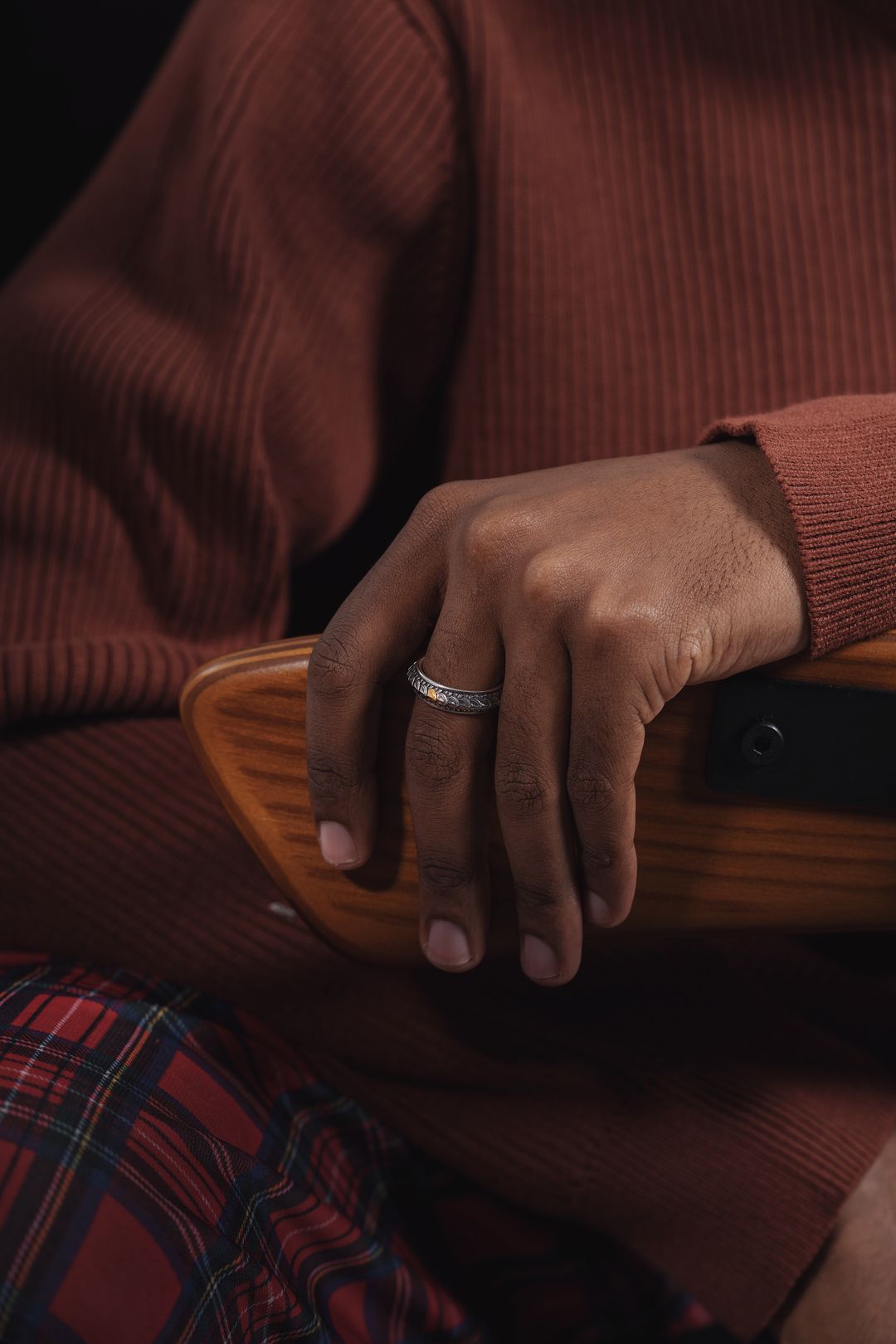
Hardness, weight, and how each metal wears
Hardness is the easy number to fight over because it's a single digit. The interesting story is what hardness does to a ring over a marriage.
A 5.5-Mohs stainless ring picks up a kind of dull, swirly micro-scratch pattern across the top of the band within the first six months of daily wear. It's not catastrophic and most guys never bother polishing it out, but the brushed-or-polished finish you bought is not the finish you'll have at your tenth anniversary. It softens and clouds, and the finish becomes "lived-in" whether you wanted that look or not.
A 9-Mohs tungsten ring resists that pattern almost entirely. The brushed lines stay crisp, the polished mirror stays mirror, and the edges stay sharp. If you put a brand-new stainless ring next to a five-year-old tungsten ring under a phone flashlight, the stainless will already look older than the tungsten will at twenty.
Weight tells the opposite story. Tungsten has a density of about 19.25 grams per cubic centimeter, almost twice the density of steel (roughly 8 g/cm³). A typical 8mm tungsten band weighs around 14 to 16 grams on a US size 10 finger. A comparable stainless steel band might come in at 7 to 9 grams. If you want a wedding band that reminds you it's on your hand, tungsten delivers. If you want something you can forget you're wearing, stainless is genuinely lighter.
Most guys adapt to the heft of tungsten within two weeks of daily wear. After that, the weight becomes part of the ring's identity. There's a reason the rings that read as "serious" tend to be the dense ones. But it's worth knowing up front, because you can't change a tungsten ring's weight, and it's the spec people most often forget to ask about. For the full breakdown on how tungsten compares to other metals on the scale, our tungsten weight guide goes deeper.
Tungsten vs stainless steel ring: side-by-side spec table
| Spec | Tungsten Carbide | Stainless Steel (316L) |
|---|---|---|
| Hardness (Mohs) | ~9 | 5.5 to 6 |
| Density (g/cm³) | ~19.25 | ~8.0 |
| Feel on the hand | Heavy, anchored, present | Light, easy to forget |
| Scratch resistance | Resists almost everything | Picks up swirl marks early |
| Tarnish / corrosion | Does not tarnish | Resists rust, can dull over time |
| Hypoallergenic | Yes (nickel-bonded versions are skin-safe) | Yes (316L is the surgical-grade standard) |
| Resizable | No, replace with new size | Yes, most jewelers can resize |
| Engravable | Laser only (interior) | Hand or laser engraving |
| Emergency removal | Cracked with vise grips (designed to break cleanly) | Cut with a standard ring cutter |
| Typical price (men's band) | $80 to $300 | $25 to $150 |
| Long-term look | Same on day one and year ten | Softens and clouds over time |
When a stainless steel ring actually makes sense
It's easy to read this comparison and write off stainless steel entirely. That's not the right call. Stainless has real strengths that line up with specific situations.
You want a placeholder, not a forever ring. If you're getting married next month and don't want to commit to a final band yet, or you're traveling somewhere you don't want to wear an expensive ring, a $40 stainless band is genuinely the right answer. Lose it, scratch it, replace it, no drama.
You expect your finger size to change. If you're actively losing or gaining weight, recovering from a finger injury, or in a job where your hands swell seasonally, stainless gives you the option to resize. Most jewelers can take a stainless band up or down a full size without rebuilding it. Tungsten can't be resized at all. When the size changes, you replace the ring. (Read our tungsten resize guide for what to do when this happens.)
You want a featherweight band. Some guys never adjust to the density of tungsten. If you've never worn a ring before and want something you can genuinely forget about within the first hour, stainless at 7 to 9 grams is meaningfully lighter than tungsten at 14 to 16. This matters more for narrow framers and guys who type all day.
You want hand-engraving on the outside. Engraving on tungsten is laser-only and interior-only. The surface is too hard for a graver. If your tradition calls for a hand-cut outer engraving, an heirloom motif, a sentence around the band, a hand-stamped date, stainless takes the tool and tungsten doesn't.
Cost, sizing, and what you can engrave on each
Stainless steel rings are cheaper across the board. A basic 316L band can be had for $25 from a department-store counter. A nicer stainless ring with a brushed finish, comfort-fit interior, and a few design details tops out around $150 unless you're paying for a brand. The metal itself is cheap and the manufacturing is straightforward.
Tungsten is more expensive per ring, but only because the manufacturing is fundamentally different. Tungsten carbide has to be formed under pressure. The powder is compressed into a mold, heated to roughly 1,400°C, then ground and polished from the resulting blank. There's no casting step the way there is for steel. Most tungsten bands land in the $80 to $300 range. Skip anything cheaper than $50. That's a sign of unbonded or low-percentage tungsten that won't behave the way real tungsten carbide does.
Sizing rules differ in a way that matters. A stainless ring can be cut and re-soldered to a new size by most local jewelers. A tungsten ring has to be replaced. But every reputable tungsten brand operates a lifetime size exchange for exactly this reason. You buy size 10 today, your finger ends up size 11 next year, you send the original back and get a fresh size 11, no money lost. Always check the size policy before you buy a tungsten band. That's the spec that protects you from the only real downside.
Engraving is laser-only on tungsten and interior-only. The surface is too hard for a hand graver to bite into. Most couples treat the interior as the spot for a date, a name, or a short line. It's hidden from daily view and only visible to the person wearing the ring. Stainless takes anything: hand engraving, laser, deeper machine cuts. If outer engraving matters to you, lead with that constraint before you decide on metal.
Why tungsten wins for a daily-wear wedding band
Wedding bands are a category of jewelry that has to do something most jewelry doesn't: get worn every day, on the same finger, through every activity, for decades. That's a brutal duty cycle, and most jewelry metals weren't designed for it.
Gold scratches and silver tarnishes. Even titanium, which is genuinely tough, picks up its own visible wear pattern over time (covered in detail in our tungsten vs titanium guide). Stainless steel takes scratches earlier than any of them. Cobalt chrome sits in the same softer tier as stainless on the hardness scale, which we break down in our tungsten vs cobalt comparison.
Tungsten is the only common ring metal that's been engineered specifically for the duty cycle of a wedding band. The 9-Mohs hardness means most things that touch the ring during a normal day (door handles, gym equipment, kitchen prep, tool work, granite countertops) won't leave a visible mark. Tungsten is also chemically inert, so the ring won't oxidize, won't tarnish, won't react with chlorinated pool water, salt water, sweat, or hand sanitizer.
Then there's the heft, and there's something to a ring that has weight to it, a quiet anchoring presence on the hand that a 7-gram stainless band doesn't quite have. Wedding bands are symbolic objects. Most guys, after the first two weeks, end up preferring the weighted version. (For where tungsten lands against other heavy contenders, our tungsten vs titanium strength breakdown covers the comparison head-on.)
The two FoundryCut bands most often cross-shopped against a stainless steel option are Ingot, a silver matte beveled tungsten band that hits the cleanest classic profile in the catalog, and Monolith, the bestseller, a black matte beveled tungsten available in both 6mm and 8mm widths. Both are nickel-bonded tungsten carbide built for daily wear. If a silver look is specifically what you are after, our guide to men's silver wedding bands breaks down silver-tone tungsten against sterling silver.
How to choose between the two for your hand
The decision usually comes down to four questions. Answer them honestly and the right metal picks itself.
Are you committing to this ring for a long time, or hedging? If you want one band that looks the same at year ten as it did on day one, tungsten. If you want a placeholder, a travel band, or something you can lose without losing sleep, stainless.
Is your finger size stable? A stable size points to tungsten, an actively changing one to stainless (or a tungsten brand with a strong lifetime exchange program, verify before you commit).
How important is weight? Want presence on the hand and it's tungsten, want featherweight and it's stainless. There's no in-between, because the density gap between the two metals is too large to fudge.
Do you need outer engraving? If you absolutely need a hand-cut outer engraving, stainless. If interior laser engraving works for your needs (which it does for most couples), tungsten gives you everything else.
If you scored tungsten on the first and third questions, you're a tungsten guy. That's the most common answer by a wide margin among our customers. The full tungsten lineup spans plain matte through black, two-tone, and inlay styles. The silver-finish collection is the cleanest starting point if you're cross-shopping a stainless look.
Common questions about tungsten vs stainless steel rings
Is a tungsten ring stronger than a stainless steel ring?
Yes, by a wide margin in terms of hardness. Tungsten carbide is roughly 9 on the Mohs scale. 316L stainless steel is 5.5 to 6. That means tungsten resists scratches from almost everything in daily life, while stainless will pick up visible swirl marks within the first few months of wear. Stronger in the sense of impact resistance is a different question. Tungsten is harder but more brittle, so a severe impact on a stone floor can crack a tungsten ring, while stainless would deform instead.
Will a stainless steel wedding ring rust?
316L surgical-grade stainless will not rust under normal wear. The chromium in the alloy forms a passive oxide layer that protects the iron underneath from corrosion. Lower grades of stainless steel can rust if the chromium content is too low, which is why it's worth confirming the grade before you buy. A cheap stainless ring with no grade listed is a red flag.
Which metal is better for working with your hands?
Both are better than gold or silver, but for different reasons. Tungsten is the better cosmetic choice, since it won't show scratches from tools, machinery, or rough work. Stainless is the better practical choice if your hands swell or shrink seasonally, because it can be resized. For most trades, mechanics, construction, lab work, kitchen work, tungsten is the more popular pick because the finish stays clean. (Both are also non-conductive enough to be safer than gold around general workplace electricity, but if you work as an electrician on live circuits, silicone is still the answer.)
Can you resize a tungsten or stainless steel ring?
Stainless steel can be resized by most local jewelers, typically up or down by a full size without much trouble. Tungsten cannot be physically resized. The material is too hard for a jeweler's normal sizing tools. Most reputable tungsten brands offer a lifetime size exchange instead, where you send the original back and they ship you a new ring in the correct size. Check the exchange policy before you buy.
How long will a tungsten ring last compared to a stainless steel one?
Both will outlast a gold ring under daily wear. The difference is in how they age. A tungsten ring tends to look the same at year ten as it did on day one. The brushed lines stay crisp, the polished mirror stays mirror. A stainless steel ring will pick up a lived-in finish over the same period: visible swirl marks, softened edges, and a slightly cloudier surface. Both can be re-polished if the look starts to bother you, but tungsten generally doesn't need it.
Are tungsten and stainless steel both hypoallergenic?
Yes, in their wedding-band grades. 316L stainless steel is the standard for surgical implants because of its low reactivity with skin. Nickel-bonded tungsten carbide is also skin-safe. The nickel is fully bonded inside the carbide matrix and isn't free to react with skin. Avoid cobalt-bonded tungsten rings if you have a known cobalt sensitivity, and avoid lower-grade stainless that may have higher nickel content at the surface.
If you are still weighing the broader case for tungsten as a daily band, our tungsten rings pros and cons guide covers every advantage and downside in one place.
Most guys who cross-shop tungsten and stainless end up at tungsten. The long-term look, the heft, and the fact that the ring stops scratching on day one is hard to argue with. If you want to see what a clean nickel-bonded tungsten band looks like in person, Ingot in silver matte is the closest analog to a stainless steel finish, and Monolith covers black matte in both 6mm and 8mm. Both ship with lifetime size exchange, the only spec where stainless used to have an edge.


