
Tungsten vs cobalt is a tighter battle than tungsten vs titanium since they are more similar too. They both serve in the same way as a 'gold alternative' for men's wedding bands. They are both more wear resistant and brighter than gold. In this case they are comparable. Tungsten carbide achieves a Mohs hardness of 9, while cobalt chrome hovers around a hardness of 5 or 6. This is one defining difference that you can really feel.
This guide on tungsten vs cobalt centers around the things that matter most to a man shopping for a wedding band. These include scratch resistance, weight, color, comfort, what will happen in an emergency, and how each ring will look in a decade. We will stick to straightforward language, no complicated phrasing or jargon.
What is cobalt chrome?
Cobalt jewelry isn't pure cobalt. It's a cobalt-chromium alloy borrowed from aerospace and medical implants, typically 60 to 70 percent cobalt and 25 to 30 percent chromium, with smaller amounts of tungsten, molybdenum, or silicon to fine-tune hardness and corrosion resistance. The chromium gives it a bright, almost platinum-white surface, and the cobalt makes it dense and tough. The result is a metal that's harder than gold but more forgiving than tungsten carbide.
Tungsten carbide is a different beast. It isn't an alloy in the traditional sense, it's a ceramic-metal composite where tungsten carbide grains are bonded together with a nickel or cobalt binder under extreme heat and pressure. For why that compound behaves so differently from the raw element, see our guide to tungsten carbide vs tungsten. The finished material is closer to a ceramic in hardness than to a metal in ductility, which is why a tungsten band can shrug off years of scratches but will crack rather than bend under a sharp impact.
If you are looking into the rarer and more expensive metals, you can look at our guide comparing tantalum and tungsten rings.
Tungsten vs cobalt: head-to-head specs
Pull the spec sheets side by side and the gap becomes obvious. Tungsten carbide leads on hardness, scratch resistance, and density. Cobalt leads on impact resilience, color brightness, and the ability to be cut or worked by a standard jeweler's tools. Neither is universally better, they're built for different priorities.
| Spec | Tungsten Carbide | Cobalt Chrome |
|---|---|---|
| Mohs hardness | ~9 (just below diamond) | ~5-6 (similar to titanium) |
| Density | 14.5-15.0 g/cm³ | ~8.3-8.9 g/cm³ |
| Feel on the hand | Heavy, substantial | Medium, heavier than titanium, lighter than gold |
| Native color | Gunmetal gray (cool, slightly darker) | Bright white (platinum-like) |
| Scratch resistance | Excellent, top of the wedding-band field | Good, better than gold or silver, well below tungsten |
| Impact behavior | Brittle, can crack on a sharp drop or vise pinch | Ductile, bends or dents instead of cracking |
| Resizable | No, too hard to work | Yes, within a limited range (typically 1/2 to 1 size) |
| Emergency removal | Cracked off with a ring cracker (no rotary saw needed) | Cut off with standard jewelry shears or rotary saw |
| Hypoallergenic | Yes when nickel-bonded (FoundryCut spec) | Generally yes, chromium reduces nickel exposure, but check the alloy spec |
| Style availability | Broad: black, gold, rose, inlays, hammered, brushed, polished | Narrower: mostly white/silver, fewer inlays and finishes |
The spec table is the headline. The next sections walk through what each row means for a guy wearing the ring every day.
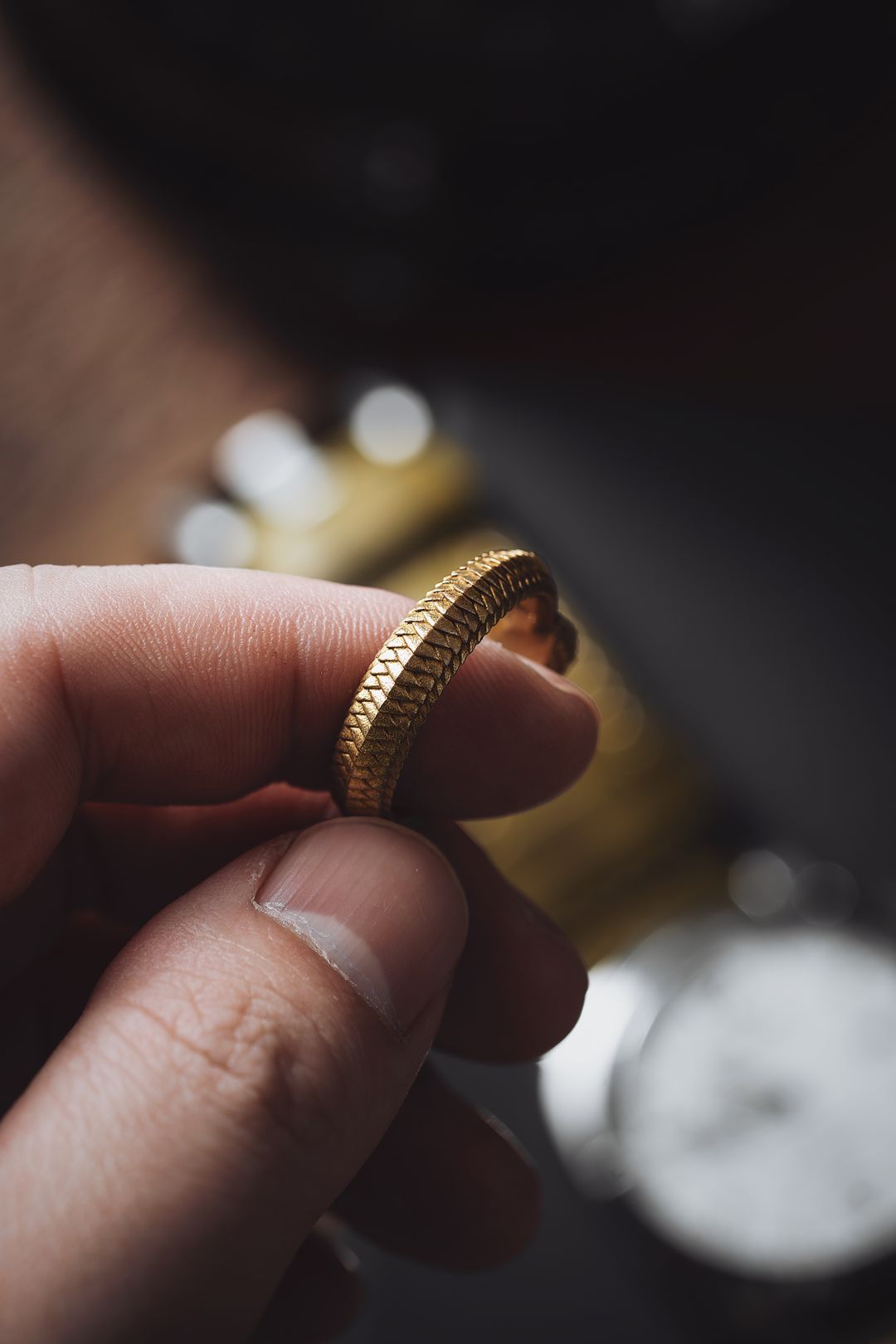
Does cobalt chrome scratch easily?
Cobalt is harder than gold, platinum, and silver, enough to handle desk jobs and light tool use. But the bigger gap is between tungsten and cobalt: tungsten sits at a 9 on the Mohs hardness scale while cobalt sits at 5 to 6, and sand and grit come in around a 7. That means sand and grit can mark cobalt over time, but they aren't hard enough to harm tungsten.
A five-year-old gold band shows what regular wear looks like on a soft metal: a dull, scratched surface that needs polishing to recover its shine. Cobalt is more wear-resistant than gold, but it's on the same scale, while tungsten is on a different one entirely. A tungsten ring worn for a decade looks like the day it was made, unless it's been hit hard enough to crack.
Cobalt and Tungsten also differ on the impact side of the scale. Cobalt is ductile and can bend and dent, while Tungsten is brittle and cannot bend. While this brittle-ductile difference does not matter on a daily basis for the average person, it is good to consider if you are in an environment where your ring can get pinched between a hard surface and a hard metal. For more, read our breakdown of tungsten rings: pros and cons.
Is tungsten heavier than cobalt chrome?
Tungsten carbide is denser, almost twice the density, than cobalt chrome. It translates to rings that feel heavy, planted, and present. Cobalt is closer to platinum, feeling heavier than titanium, but significantly lighter than tungsten. Some guys want the weight of tungsten and dislike anything lighter, while others prefer cobalt for a medium weight, and it comes down to personal preference.
Both metals have comfort fit and can be made into flat, domed, or beveled profiles with a smooth interior, but they differ in sizing. Cobalt can be resized to a half size, while tungsten can't be resized at all and needs to be traded for a new size. This can be done during a manufacturer warranty exchange, which is why companies like FoundryCut offer free size exchanges.
Weight matters less for routine fit and more for how you will notice the ring throughout the day. To get a deeper understanding of density across all the popular wedding band metals, check our how heavy is tungsten.
Color, finish, and styling
Cobalt's strongest selling point is its color. It is the whitest metal, almost resembling platinum, making it one of the most affordable wedding band metals. Cobalt is a winner for that look of "white gold without the upkeep".
Tungsten's native color is a darker, cooler gunmetal gray. Some men prefer that: it reads as distinct from gold, silver, or platinum and signals "I chose something modern." Others want the platinum look, in which case cobalt or rhodium-plated tungsten is closer to that target. Tungsten finishing tricks, like polished, brushed, satin, hammered, or two-tone, can push the appearance brighter or darker as needed.
The styling gap goes wider when you look at finishes and inlays. Tungsten is the most versatile alternative wedding-band metal on the market: jet black, rose gold, multi-color inlays, hammered textures, cosmic stone inlays, antler inlays, wood inlays, basically any style that's possible in a men's band. Cobalt is mostly available in plain white or silver-matte finishes, with a much shorter list of inlay options. If you want a black band, a hammered band, or a band with character beyond a plain silver loop, tungsten gives you far more choice. Browse the tungsten rings collection to see what that range looks like in practice.
Cost and long-term value
Both tungsten and cobalt land in the same affordable-alternative-metal price tier: well below gold, well below platinum, and roughly comparable to titanium. Pricing varies by brand, style, and inlay choices more than by metal alone. The bigger value question isn't sticker price, it's what you get for the money over time.
A tungsten ring that costs less than a tank of gas can look identical after ten years of daily wear. A cobalt ring holds up better than gold but shows wear faster than tungsten, with small surface scuffs that accumulate. Treat your wedding band like jewelry and rotate it off for rough activities, and both metals will outlast their owner. Wear it through everything, gym, yard work, mechanic shop, kitchen, and tungsten's hardness pays off.
If you're looking for a general idea of what you can expect to pay for a wedding ring based on different types of metals, check out our guide on how much a wedding ring should cost. It breaks everything down for you without trying to sell you on anything.
Cobalt chrome: the honest pros and cons
Taking the marketing fluff away from the metal, cobalt chrome has a few real strengths and a couple of honest trade-offs. Here's where it earns its place, and where tungsten pulls ahead.
Where cobalt chrome wins:
- It bends before it breaks. Cobalt is a metal alloy, so under a hard enough hit it deforms instead of cracking, while tungsten carbide is a ceramic-like compound that can chip or crack under the same hit.
- Limited resizing helps too: a jeweler can move a cobalt band about half a size either way, while tungsten cannot be resized at all. For a finger that swells in summer or after the gym, that flexibility is worth something.
- Bright white color rounds out the list. Cobalt chrome runs whiter and brighter than tungsten's cooler gray, landing closer to platinum or white gold if that's the look you're after.
Where cobalt chrome falls short:
- It marks up faster, since at Mohs 5 to 6 cobalt collects fine scratches over years of daily wear while tungsten at Mohs 9 shrugs off the same grit. For a surface that stays sharp with zero babying, tungsten is the honest answer.
- Price and selection work against it too. Cobalt bands usually cost more than comparable tungsten, and the range of styles is thinner. You pay more for a softer surface.
- Alloy quality varies too, since cheaper cobalt blends can carry more of the metals that trigger skin reactions, and quality control across the market is less consistent than tungsten's.
That trade-off is the same one tungsten faces against harder but more brittle rivals, which we break down in whether tungsten is stronger than titanium. And if the price gap is driving your call, our tungsten ring price guide shows what an honest number looks like in 2026.
Resizing, repair, and emergency removal
This is the most-asked question in tungsten vs cobalt comparisons: what happens if my finger swells, or if I get the ring stuck?
Cobalt can be resized by a jeweler within a roughly half-size window. Anything bigger and the metal will be stressed past its working range. It can also be cut off in an emergency with standard jewelry shears or a rotary saw, the same tools an ER uses on titanium and gold.
Tungsten can't be resized at all. The material is too hard to compress or stretch without cracking. What you can do, and what every reputable tungsten retailer offers, is a free size exchange: send the old ring back, get a new size sent out, no charge. Emergency removal is also straightforward despite the rumors. Tungsten is brittle, so an emergency room or fire crew uses a ring cracker to crack the ring at the point of maximum pressure and it falls off in two pieces, with no rotary saw, and the clinician shims the finger before applying force. Our dedicated post on whether a tungsten ring can be cut off walks through the procedure step by step.
Which holds up better on the job
Most guys who cross-shop tungsten and cobalt work with their hands, so the real question is which band survives a shift without becoming a liability, and the answer splits by trade.
For grinding, lifting, and anything abrasive (construction, warehouse, landscaping, auto work), tungsten's Mohs 9 surface wins. Cobalt at Mohs 5 to 6 picks up swirl marks and scuffs from the same grit far sooner, so if your ring spends its day against concrete, tool steel, or a truck bed, the harder surface stays clean longer. We ranked those trade-offs by job in our guide to the best wedding bands for mechanics and construction workers.
Electrical work changes the framing: both tungsten and cobalt conduct electricity, so neither is safe around live circuits or treated as insulation. If that's your trade, the deciding issue isn't tungsten versus cobalt, it's whether a hard metal band belongs on your hand on the clock. We cover the safety math in is tungsten conductive.
Net: for abrasive, dirty, hands-on trades, tungsten's surface hardness is the edge most guys feel day to day. Browse the everyday-wear profiles across the full FoundryCut collection to see what that looks like.
Which one should you choose?
Pick cobalt if a bright, platinum-white color is your top priority, you want a little resize room, and you'll accept faster surface wear in exchange. Pick tungsten for maximum scratch resistance, a wider style range (black, gold accents, inlays, hammered finishes), and you don't mind the heavier feel.
For guys deciding between these two metals, the main deciding factor is style, not durability. Cobalt is bright silver, while tungsten can have many different looks based on finish. If you're already sold on tungsten and comparing other alternatives, our tungsten vs titanium and tungsten vs ceramic guides cover the next layer. Comparing silicone backup bands? We cover tungsten vs silicone and our tungsten vs stainless steel guide is the cheapest comparison.
If you're picking tungsten, we have two FoundryCut rings that cover most use cases. Ingot is our matte tungsten that's closest to a cobalt ring and is a whole lot more durable. Monolith comes in 6mm and 8mm and is our most popular black tungsten, for guys who want a band that doesn't read as silver.
Common questions about tungsten vs cobalt
Is tungsten or cobalt harder to scratch?
Tungsten holds up against scratches a whole lot better than cobalt. Tungsten carbide is near a 9 and cobalt is a 5 to 6 on the Mohs scale. The worst scratches we see on rings in the everyday environment come from grit or sand, typically around a 7, and that's enough to mark cobalt. For everyday rings, tungsten is a clear winner.
Can a cobalt ring be resized?
Yes, but only within a limited range, usually about a half size up or down. Tungsten is a hard metal that's too hard to work with standard jeweler's tools, so most tungsten brands do size exchanges for free instead.
Which is heavier, tungsten or cobalt?
In general, tungsten is much denser than cobalt chrome. Tungsten carbide has an even larger margin with a density of 14.5 to 15.0 g/cm³, while cobalt chrome lands at about 8.3 to 8.9 g/cm³. This means that a tungsten band has a heavier feel, while a cobalt band feels closer to platinum, or even heavier, a titanium ring. Both bands are still heavier than aluminum or silicone bands.
Can a cobalt ring be cut off in an emergency?
Cobalt chrome is ductile, meaning, yes, it can be cut with traditional jewelry shears, or a rotary saw, similar to the way an E.R. doctor removes titanium or gold rings. Tungsten is removed in a much different fashion. Because it is very brittle, and breaks rather than bends, an emergency room or fire crew uses a ring cracker to crack the ring at the point of maximum pressure. While both metals are safe to wear, they both come off easily in life threatening situations.
Is cobalt or tungsten more hypoallergenic?
Both are hypoallergenic when made with good quality binders. The high chromium content in cobalt chrome means nickel exposure is even lower, though some alloys are still composed with trace nickel. Check the spec if you know you have a sensitivity. Tungsten carbide is hypoallergenic when nickel-bonded. Older cobalt-bonded tungsten can release trace cobalt and cause issues for sensitive skin.
Does cobalt look more like platinum than tungsten?
Cobalt chrome has a bright, almost white surface, and mimics platinum or white gold. Tungsten's surface is a darker gunmetal gray. Cobalt is a closer match to platinum rings for both engagement and wedding bands. Tungsten reads as a darker gray overall.
Do cobalt chrome rings tarnish or corrode?
Quality cobalt chrome is corrosion-resistant and doesn't tarnish under normal wear, thanks to the chromium in the alloy. The catch is alloy quality: cheaper cobalt blends with more reactive metals can discolor or irritate skin over time. Tungsten carbide is chemically inert and doesn't tarnish either, so the two are close on this measure for well-made rings.
Is cobalt or tungsten the better everyday wedding band?
For most guys, tungsten is the better daily driver: it holds its surface longer, costs less, and comes in far more styles. Cobalt makes sense if you specifically want a whiter metal that can flex and be resized a little rather than one that trades resizing for extreme hardness. Match the metal to your priority, whether that is surface toughness or fit flexibility.
If you want a durability-first wedding band that holds up to anything and offers the widest style range (black, silver, gold accents, inlays, hammered finishes), tungsten is the call. Monolith and Ingot are the two most-purchased starting points in the FoundryCut catalog, but the full tungsten collection covers every finish and color combination men actually shop for.


