
Wedding rings are meant to symbolize a promise that extends beyond the day the promise was made. They are circular, meaning they have no end, and, instead of being kept in a safe, are meant to be worn on the hand for all to see. Ask a dozen people what a wedding ring means, and you'll hear similar answers. Most people agree on their meanings. However, what is less understood is how much of these customs are truly traditional and what is more modern, like how much is the result of modern advertising, and how much does a man actually reflect on these things when he chooses the actual ring? This will help you discern the three so that you know what you are wearing and why.
What does a wedding ring symbolize?
A wedding ring signifies a promise with no end made in public and worn daily, the wearing of which is never discussed. The circle of the ring is meant to symbolize continuity. A wedding band is the one jewelry a man cannot stop wearing without being noticed. The daily wearing makes it a routine. It's the day-to-day part of a marriage that people don't discuss, which is what the symbolism really is, and that is actually what matters the most after years of being married.
Everything else layered on top of that is culture. Gold means one thing in one country and something else two borders away. Black bands carry associations in the United States that barely register in Europe. Even the hand changes, since plenty of countries put the ring on the right. The base meaning holds across almost all of them, and only the details move.
Why is a wedding ring a circle?
The ring with no beginning or end may be the oldest wedding ring tradition. It's said to originate in Egypt where couples would exchange woven reeds or hemp and the weave of the reeds or hemp would carry a sense of eternity. This custom is one of the many traditions surrounding marriage customs. This is a great story, but there is not a lot of solid evidence to support it.
Rome gives us more to work with, though less than it usually gets credited for. Roman betrothal involved a ring given as a pledge, a token that a bargain had been struck. The much-repeated detail that men wore plain iron day to day and kept gold for show traces largely to a single passage in Pliny, so hold that loosely too. What's solid is that the Christian marriage rite later absorbed the ring and blessed it as part of the ceremony, turning a Roman contract token into a religious symbol and then a secular one again.
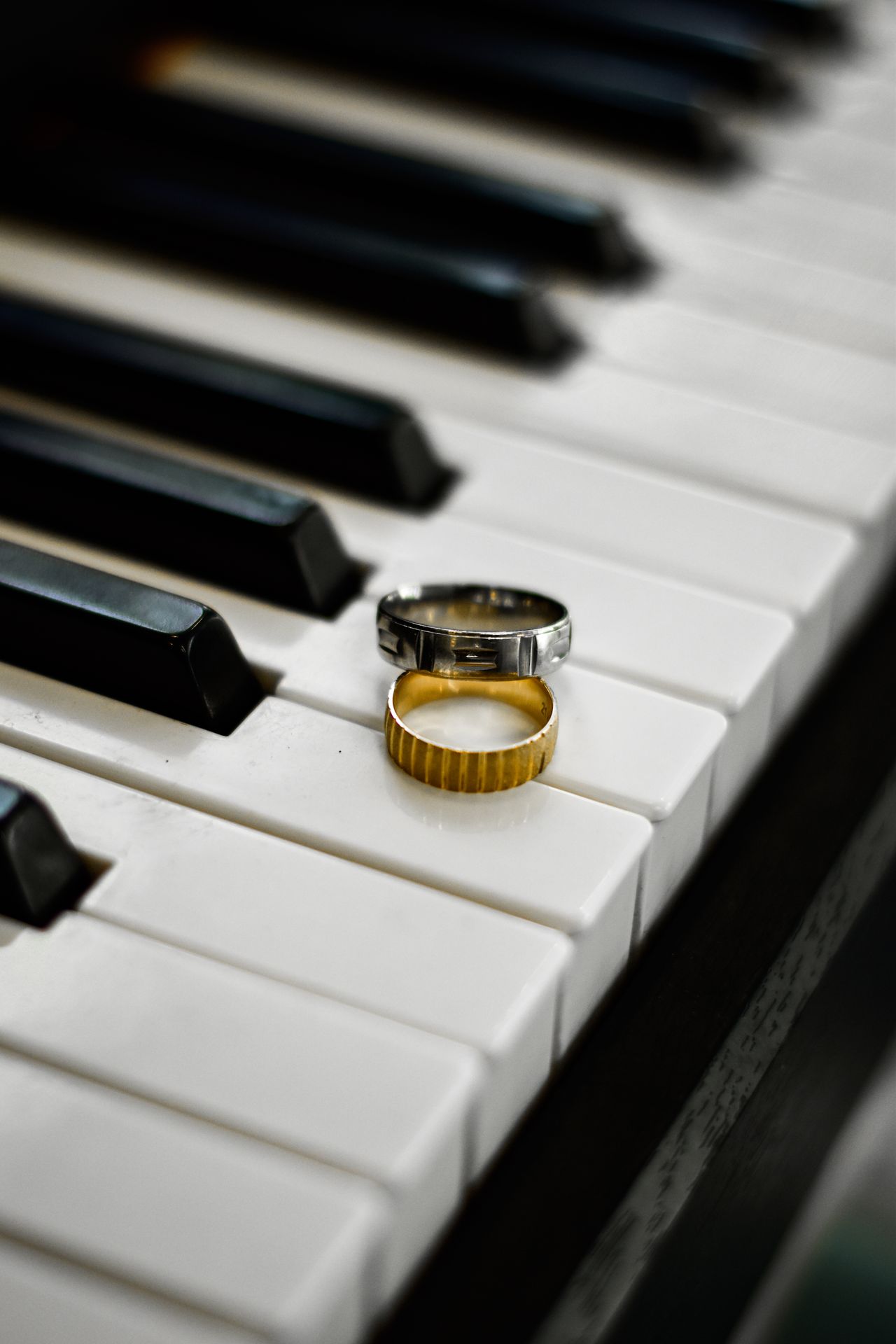
What survived every one of those handovers is the shape, not the metal, the price or the ceremony wording, just the loop.
Why is the wedding ring worn on the fourth finger?
The standard explanation is the vena amoris, a vein believed to run from the fourth finger of the left hand straight to the heart. It's a good idea and it's anatomically wrong. Every finger drains through the same network, and there's no dedicated line to the heart on either hand.
The habit stuck anyway, which tells you something about how these customs work. A reason gets attached to a practice after the fact, the reason turns out false, and the practice carries on because people like it. For the longer version of how the left hand won out in some countries and lost in others, we broke it down in why the wedding ring goes on the left hand, and the country-by-country picture sits in which hand men wear a wedding ring on. Germany, Russia, Poland and much of Eastern Europe use the right, and in India the hand varies by community and tradition rather than settling on one. Nobody in any of them thinks their marriage means less for it.
The finger itself carries a separate set of meanings when a ring shows up somewhere else on the hand, worth knowing if you wear more than one. That's covered in what a ring on each finger means.
What does a wedding band symbolize that an engagement ring doesn't?
An engagement ring symbolizes an intention. A wedding band symbolizes a state. That's the whole difference, and it explains most of the design conventions that follow from it.
An engagement ring is meant to be looked at, which is why it usually has a stone and tends to be given rather than exchanged. A wedding band is meant to be worn, which is why it's plain more often than not, why both people get one, and why the two rings share a finger in a particular order. If you're sorting out the mechanics of that, which ring goes on first and whether the band goes on top or bottom both cover it.
For men the distinction is newer than most assume. Men's wedding bands only became common in the United States around the Second World War, when servicemen leaving home wanted something to carry that said they were married. The jewelry trade had pushed double-ring ceremonies since the 1920s without much success, and the war gave that campaign a reason people accepted. Before that, a ring for the groom was the exception rather than the rule. So when someone calls the men's wedding band an ancient tradition, the accurate answer is that the ring is ancient and the men's version of it is roughly your grandfather's age. We go further into the terminology in wedding ring versus wedding band and into the men's comparison in engagement ring versus wedding ring for men.
What the metal is saying
Metal choice reads as a signal whether you intend it to or not, part genuine tradition and part what a material has come to stand for over the last twenty years. Here's the honest version of both.
| Metal | What people read into it | What it actually tells you |
|---|---|---|
| Yellow gold | Traditional, inherited, the default your parents wore | Soft enough to mark up, easy to resize, still the reference point every other metal gets measured against |
| White gold | Modern-traditional, matches an engagement ring | Usually rhodium-plated, so it needs replating every few years to hold its color |
| Platinum | Serious money, permanence | Dense and heavy on the finger, keeps its color without plating, priced well above everything else here |
| Tungsten | A working man's ring, practical rather than precious | Hard and noticeably heavy, cannot be resized, so you buy the size you'll actually wear |
| Titanium | Understated, low-maintenance, slightly technical | Very light, which some men read as barely-there and others read as the whole point |
| Silicone | The ring you wear when the real one has to come off | A second ring rather than a replacement, common in the trades and at the gym |
None of these carry an official meaning, just a read, usually about how you live rather than what you spent. A man in the trades wearing a plain gray band like Ingot is saying he wants a ring he doesn't have to think about at work, a legitimate meaning, more honest than a price tag. For the full picture on the material, tungsten rings pros and cons lays it out, and the wider range sits in tungsten rings.
Color, finish, and the meanings people read into them
The black band that raises the most questions, in general, is a personal preference for how it looks but is sometimes used to communicate a different meaning. A complete description, including the unverified statements that are repeated the most, can be found in what a black wedding ring means. It is a good read before making any assumptions regarding the meaning of what a stranger is wearing.
Finish conveys a quieter signal than color. A high polish is formal and reflects light, while a matte or brushed surface prefers discretion, sitting flush with the hand rather than announcing itself, part of why brushed rings dominate the men's category. A two-tone ring, like Helm, with a rose-gold interior, has a concealed meaning assigned by the wearer, and a personalized, private meaning is given to a second color.
Width is based on the same reasoning. A 6mm band implies restraint, an 8mm band implies intention. A larger band does not mean a person is more married than a smaller band. This choice typically boils down to the size of a person's hand, not the size of a ring. The entire men's range of products in rings is in men's wedding bands, if you would like to see variations in the same idea.
The meaning you add yourself
All of the attributes above are inherited. Thus, the engraving of a wedding band is the one place where a couple has complete control over the symbolism. This is the one feature men remember years later: a date, a set of coordinates, a two-person exclusive line, or a reproduction of the other person's hand writing on the inner band.
Space and depth are constraints that change with the metal. Harder metals only take a laser engraving as opposed to a cut one, changing what's possible and the depth of engraving. We have discussed the mechanics of tungsten ring engraving and wedding ring engraving ideas.
What the ring means once you're actually wearing it
The meaning of the ring comes from the ceremony, while daily life provides a different meaning. After a year, the band stops being a symbol and simply becomes something you notice when it's not there. Men who take off their rings for work describe the empty finger in the same way: it feels wrong, and they can't explain why. That attachment is also why men hesitate to swap the band years later, though the etiquette around upgrading a wedding ring turns on talking it through with your partner first and on what you do with the original.
This is the meaning that truly ends up mattering. A ring you can wear through an entire work shift, a workout, and a shower is a ring that is worn, and a ring that is worn fulfills the purpose of the symbolism. A ring that stays on the table for the night because it is too loose, too valuable, or too easily damaged doesn't fulfill the purpose of the symbolism. The practical and the symbolic are the same question asked twice, which is also why a wedding ring's cost is more about a person's expectations than actual worth.
If you're at the stage of choosing rather than reading, start with the shape you will wear everyday, and let the meaning follow. A plain matte band such as Monolith has just as much meaning as a band with a stone, because the meaning stems from materials.
Common questions about wedding ring symbolism
What does a wedding ring symbolize?
A wedding ring symbolizes an ongoing commitment between two people, expressed through an unbroken circle worn visibly on the hand. The circle stands for continuity, the placement makes the commitment public, and the daily wear turns it into a habit rather than a gesture.
What does a wedding band symbolize compared with an engagement ring?
An engagement ring symbolizes an intention to marry, and a wedding band symbolizes the marriage itself. The engagement ring is usually given by one person to the other, while wedding bands are exchanged, which is why both partners wear one and why bands are typically plainer.
Why is the wedding ring worn on the fourth finger?
Traditionally, people wear wedding rings on their fourth finger because of the vena amoris, or the vein of love, which was believed to run from that finger to the heart. However, this vein does not exist, and the custom persists from habit rather than anatomy. Many countries wear wedding rings on the right hand instead.
Does the metal of a wedding ring have a meaning?
No metal carries an official meaning, but each one is read a certain way. Gold reads traditional, platinum reads formal and expensive, and tungsten or titanium read practical. The read usually says more about how the wearer lives than about what the ring cost.
Do men's wedding rings have the same symbolism as women's?
The symbolism is the same, but the tradition is much younger. Men's wedding bands only became widespread in the United States around the Second World War, when servicemen wanted a visible reminder of home. Before that, a ring for the groom was uncommon.
Does a plain wedding band mean less than a decorated one?
A simple design doesn't mean boring. Simple bands have been the standard choice for most wedding rings because decoration is a style choice rather than a measure of commitment. Many men choose simple bands specifically because they plan on wearing them all the time.
A ring is unbroken circle of metal unless you put it on and decide to keep it on. Just pick a ring that fits the life you live, and it will take care of meaning all by itself. When the time comes to choose, check out the men's selection. Have a look through the men's range when you're ready to choose.


